








The Next Trend in Smart Manufacturing: Industrial Intelligence
Large-scale data applications and platform architectures have been fully validated and iteratively upgraded in industries including finance and telecommunications. Combined with the policy-driven boost of Made in China 2025, these form the preconditions for the arrival of the inflection point of industrial intelligence.
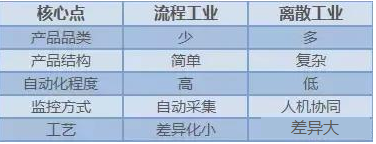
Industry is generally divided into process industry and discrete manufacturing. The most prominent differences between the two lie in the level of production automation, data accessibility and industrial complexity. Nevertheless, they share one key similarity: every scenario has unique requirements. Entering any segmented field requires profound industrial know-how and strong capabilities to integrate upstream and downstream resources.
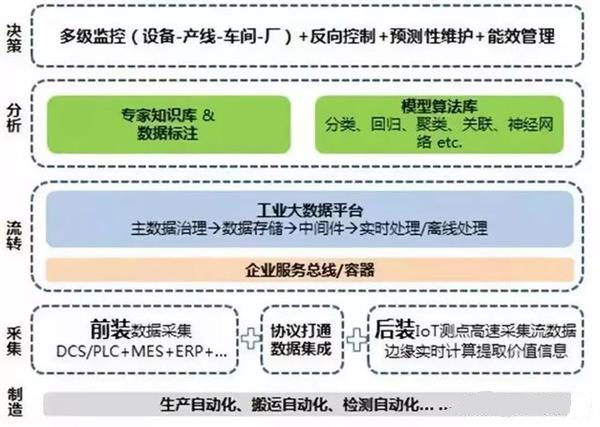
Intelligence can be interpreted as datafication plus AI built upon it. Starting with production line automation, multi-source heterogeneous industrial data is collected, transmitted and analyzed to support decision-making and process control, and end-to-end solutions have become the typical profile of industry players today.
Why Industrial Intelligence?
Blue Ocean
The total GDP generated by industry, especially manufacturing, far exceeds that of retail, finance, construction and other sectors. The volume of valid data produced daily in industrial settings is comparable to that of major Internet giants such as BAT. A large-scale factory can generate billions to tens of billions of data records every single day.
High Barriers
Although industrial scenarios produce high-frequency, massive volumes of data daily, most raw data carries no direct business value and may trigger massive transmission latency and heavy bandwidth consumption. Real-time monitoring and analysis are required for certain scenarios, while more data needs to be uploaded to the cloud for multi-dimensional and long-term economic benefit analysis — this is where cloud computing delivers value.
The integrated architecture of cloud computing plus edge computing features finer granularity and greater complexity than traditional consumer Internet architectures, which translates to higher industry entry barriers.
Inflection Point
The Internet industry follows a well-known logic called "Copy to China", and the same logic applies to industry transformation as "Copy to Industry". Large-scale data applications and platform architectures have been fully validated and iteratively optimized in finance, telecommunications and other industries. Together with policy incentives brought by Made in China 2025, these elements create the necessary preconditions for the arrival of the industrial intelligence inflection point.
Player Profile in Industrial Intelligence
At the current stage, clients demand not standalone individual products, but complete end-to-end solutions. A qualified industrial intelligence enterprise must possess the capability to build full-stack integrated solutions.
First and foremost, customer requirements always come first; any technology that fails to address real demand is meaningless. In addition, a superior solution starts with a well-designed architecture. For industrial scenarios, a closed-loop system can only be formed through full interconnection covering integration of internal and external multi-source data, cloud-edge platform architecture, knowledge base construction, appropriate model selection, and reverse decision-making & equipment control.
Overall, industrial intelligence adopts a layout of "one horizontal layer (unified overall architecture) + N vertical branches (multiple segmented industrial sectors)".
Path Selection for Industrial Intelligence
Large B-end industrial clients do not merely need single products at present; their core demand lies in end-to-end integrated solutions. While this reflects the current market reality, it also represents the ultimate goal of industrial entrepreneurs. Nevertheless, the choice of development path is critical.
Within the industry, the mainstream consensus holds that the rational development sequence for industrial enterprises is Automation → Datafication → Informatization → Intelligence, with each phase serving as an essential prerequisite for the next. For a long time, domestic industrial intelligence firms only focused on automation opportunities, even equating industrial intelligence purely with "robots" or "industrial automation".
Practical site projects demonstrate clear sequential progression among these four stages, which also overlap, intersect and iterate continuously.
Specifically, most discrete manufacturing clients suffer from insufficient automation, so they prioritize full production line automation. Some vendors realize equipment interconnection via industrial Ethernet and boards to unlock equipment-level data, feeding data back to the platform layer through MES. This lightweight IoT transformation can be deployed without replacing original industrial control equipment, winning high customer acceptance and driving multi-fold annual revenue growth — a clear upward trend. This model can be defined as system integration centered on M2M equipment IoT.
More advanced demand emerges from super-large leading discrete manufacturers and nearly all process industry clients, whose highly automated production lines render them more receptive to informatization upgrades.
Another type of vendor starts with top-level design, delivering industrial big data platforms or scenario-based AI model services at the platform layer to resolve real-time operational challenges. Meanwhile, at the data collection layer, they deploy supplementary sensors, intelligent inspection equipment and partial production line integration for sections with incomplete data collection. This model usually gains higher customer recognition and delivers higher project premiums, categorized as system integration centered on data applications.
Three distinct development paths exist to match different clients, scenarios and development stages:
1.System integration centered on production line automation;
2.System integration centered on M2M equipment IoT;
3.System integration centered on data applications.
Ultimately, all paths converge to deliver full-stack integrated solutions centered on fulfilling customer demands.
Industrial Big Data Under Industrial Intelligence
Where Does Industrial Data Originate?
1.Management Data
Predominantly structured SQL data, including product attributes, process parameters, production records, procurement, orders and after-sales service data. This category is mainly generated by enterprise ERP, SCM, PLM and MES systems. Though low in volume, it holds tremendous mining potential.
2.Machine Operation & IoT Data
Mostly unstructured streaming data, such as equipment operating conditions (pressure, temperature, vibration, stress, etc.), audio & video streams and log texts. Collected from equipment PLC, SCADA and external sensors, this dataset features massive volume and high collection frequency, requiring local preprocessing powered by edge computing.
In summary, fragmented and isolated scenarios give industrial data inherent characteristics of massive volume, multi-source heterogeneity and stringent real-time requirements. These traits will become more prominent as 28 billion devices connect to the network in the future. This constitutes one of the core challenges of industrial big data services, which differ drastically from Internet big data in volume, data structure and application logic.
What Services Should the Platform Layer Deliver Based on Industrial Data?
1.Comprehensive Protocol Parsing
Data collection relies first on compatibility with all mainstream industrial protocols. Among application-layer protocols, EtherNet/IP and PROFINET occupy the largest market share, followed by EtherCAT, Modbus-TCP and EtherNet POWERLINK.
2.Standardized Data Integration
Collected data requires unified master data management starting with standardized specifications. Enterprises generally adopt ISO or other industrial standards to unify data encoding, structure, transmission logic and attribute definitions to guarantee data consistency — a vital foundational step.
During project implementation, enterprises gradually accumulate industry knowledge bases, algorithm components and mechanism models. This transition from data standardization to business standardization lays the groundwork for microservice-oriented productization.
3.Robust PaaS Support
The unique attributes of industrial data demand powerful middle-layer platform capabilities. Take time-series databases as an example, which store sensor and equipment condition data featuring ultra-high frequency and large data volume. Traditional relational databases suffer from poor throughput and performance when computing such datasets, as they must load all historical values for each calculation. Therefore, a high-compression, high-performance time-series database is an indispensable core platform capability.
What Application Scenarios Can Be Built?
1.Equipment Level: Quality Control
In the era of industrial intelligence, accessible real-time data combined with equipment-specific mechanism models enables machine learning to identify correlations or causal relationships between product quality and key operational parameters. This supports real-time online quality control and early fault warning. If data collection frequency fully covers the entire production workflow, enterprises can achieve maximum efficiency gains.
2.Plant Level: Production Scheduling
The ultimate goal of industrial intelligence is mass customized manufacturing, namely C2M (Customer-to-Manufacturer). Production scheduling optimization targets maximum site capacity output under constraints including production line equipment, labor, product specifications and supply chain data. Models trained on historical data can generate accurate predictive outputs.
Leveraging real-time factory and production line data, these models conduct dynamic analysis and scheduling adjustments to help enterprises precisely control production and maximize economic returns.
In the foreseeable future, improved data integrity, reliability and diversified scenarios will foster a large number of outstanding data application vendors. These enterprises help industrial clients cut costs, boost efficiency and solve tangible operational pain points.
Source: Information and Software Service Network