








In-depth Analysis | All About Smart Manufacturing
Equipment manufacturing industry is the cornerstone of a nation and the bedrock of manufacturing sector, undertaking a vital mission in transforming China’s manufacturing industry from large-scale to high-quality development. With successive rollouts of policies targeting smart manufacturing, China’s manufacturing sector is steadily shifting toward intelligent production and extensively adopting technologies including cloud computing, big data and industrial robots.
Driven by the deep integration of new-generation information technologies such as artificial intelligence, big data and the Internet of Things with traditional manufacturing technologies, smart manufacturing has become the primary development direction of China’s manufacturing industry. This paper will then analyze the market scale and trends of the smart manufacturing industry in 2018 and 2019.
Overview of the Development of the Smart Manufacturing Industry
Smart manufacturing refers to a new production mode featuring perception, learning, decision-making, execution and adaptability. It is built on the thorough integration of new-generation information and communication technologies and advanced manufacturing technologies, covering all links of manufacturing activities including design, production, management and service.

China's Smart Manufacturing Market Size to Exceed 1.9 Trillion Yuan in 2019
Driven by national policies and technological transformation and upgrading of the manufacturing sector, China’s smart manufacturing industry has achieved rapid development and exerted profound impacts on industrial evolution and labor division patterns.
Statistics from Report on Market Prospects and Investment Strategic Planning of China Smart Manufacturing Industry released by Forward Business and Intelligence Co., Ltd. show that the market size of China’s smart manufacturing industry hit 818.1 billion yuan in 2014.
The market scale broke the 1-trillion-yuan threshold in 2015, and reached 1.515 trillion yuan by 2017, representing a year-on-year growth of 22.6%. It was projected to reach 1.6867 trillion yuan in 2018, and exceed 1.9 trillion yuan in 2019.
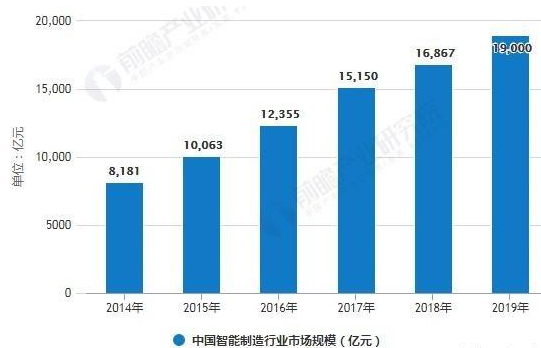
Statistics and Forecast of China's Smart Manufacturing Industry Market Size (2014-2019)
Data Source: Compiled by Forward Business and Intelligence Co., Ltd.
Ten Major Development Trends of China’s Smart Manufacturing Industry Forecasted for 2019
As one of the core driving forces of China’s manufacturing sector, the smart manufacturing industry will maintain steady growth amid continuous favorable policies and grow increasingly important for domestic manufacturing. From the perspectives of development prospects, technology integration and business models, ten major trends of China’s smart manufacturing industry in 2019 are outlined as follows:
1.Temporary headwinds cannot halt the sustained boom of smart manufacturing
At present, the adoption rate of industrial robots has reached saturation in mature sectors such as automobile manufacturing and electronics production. Driven by enterprises’ internal demand and motivation for digital, networked and intelligent transformation, smart manufacturing will gradually penetrate traditional industries including metallurgy, petrochemicals, textiles and construction machinery, keeping its growth momentum strong.
2.Industrial scenarios with profound technical depth will become breakthrough points for extensive "AI+" applications
The deep integration of artificial intelligence and industry will shift from general technical fields to specialized scenarios with profound technical depth, forming a closed-loop application chain covering upstream design and raw material feeding, midstream manufacturing and human-machine collaboration, downstream after-sales service, monitoring and operation & maintenance, as well as subsequent guidance for industrial design and technical upgrading.
3.Building a precise closed-loop data flow will be the key to constructing a smart manufacturing ecosystem
With fundamental changes in the attributes of industrial data, the value of industrial big data has gained growing recognition. Industrial data will evolve from consumer data and general industrial big data to precise data streams in the future. Establishing a closed-loop precise data flow covering collection, analysis, conversion and feedback links is critical to building a sound smart manufacturing ecosystem.
4.Focus on segmented industries and scenarios will guide internet enterprises to expand into industrial sectors
Internet companies boast inherent advantages in technology and platforms when entering the industrial space. China’s "Internet + Smart Manufacturing" initiative has delivered initial achievements, represented by Alibaba Cloud’s industrial brain, Baidu’s smart factories and JD’s intelligent supply chains. Going forward, targeting specific industrial segments and scenarios will serve as a core entry point for internet players developing smart manufacturing businesses.
5.Industry-specific industrial internet platforms will take the lead in exploring market-oriented business models
General-purpose industrial platforms feature limited technical depth, leading to mismatched market supply and demand and weak enterprise willingness for cloud migration; mature commercial operation models have yet to be formed. By contrast, industry-specific industrial internet platforms balance targeted vertical expertise and universal applicability. Catering to diverse demands across manufacturing sectors, they are expected to pioneer viable market-oriented business models.
6.The core driver of industrial enterprises’ added value will shift from equipment value mining to customer value mining
Industrial development is shifting from product-driven demand to demand-driven production. To boost industrial added value, smart manufacturing will gradually move beyond cost reduction and efficiency improvement in production links toward delivering high-value derivative services. Namely, the "smart services" enabled by "smart products" manufactured via smart manufacturing will become the primary driver of profit growth for industrial firms.
7.Information security will be a vital decision-making factor for enterprises pursuing intelligent upgrading
Digital assets including core industrial data, key technical patents and customer information have become enterprises’ most valuable intangible assets. At present, China’s data security regulatory framework and supervision mechanisms remain incomplete, slowing the pace of corporate intelligent transformation. In the future, enhancing end-to-end data lifecycle security to boost enterprises’ trust and willingness to migrate business to the cloud will weigh heavily on their intelligent upgrade decisions.
8.Smart manufacturing system integration will be deeply rooted in vertical industries
As comprehensive integrated services, smart manufacturing system solutions face dual pressures: capital occupation on both upstream and downstream sides, plus high demand for professional technical talent within teams. A broad-based expansion strategy covering all sectors will impose a heavy operational burden on enterprises. Moving forward, system integrators with deep specialization in segmented vertical industries are poised to lead industrial development.
9.High-value-added manufacturing will be the optimal entry point for additive manufacturing in industrial applications
Additive manufacturing features a high minimum production cost and flexible upper cost limit, lacking cost competitiveness for desktop equipment and mass production of simple crafts, which restricts its large-scale commercial rollout. However, manufacturing ultra-high-value, large customized single products such as aero engines, wind turbine blades and submarine propellers will become the ideal industrial application scenario for additive manufacturing technologies.
10.Automotive and 3C industries will spearhead the accelerated popularization of digital twin technology
As the preferred solution for corporate digital transformation and smart factory construction, digital twin technology will be widely deployed first in automobile and electronics manufacturing with mature processes, covering three dimensions: digital twins of products, production workflows and equipment. It is estimated that by 2020, at least 50% of manufacturers with annual revenue exceeding 1 billion yuan will launch at least one digital twin project for their products or production assets.
Source: Information and Software Service Network