





Path Analysis from Lean Production to Smart Manufacturing
Lean management focuses on the continuous improvement of operational efficiency and the full utilization of resources, with human initiative as its core driver. It advocates continuous learning and iterative optimization to steadily enhance enterprises’ competitiveness. Eliminating waste is a method to maximize resource utilization and cost efficiency, ultimately achieving the maximum operating profit margin for the business.
In our era, there is an unprecedented flood of manufacturing-related concepts: Lean Production, Smart Manufacturing, Industry 4.0, Digital Factory, Industrial Internet of Things, Industrial Big Data, Artificial Intelligence, and more.
Countless such buzzwords prevail across the manufacturing sector, yet they often leave people confused. Everyone seems to have a superficial grasp of manufacturing, yet their explanations only baffle audiences further. How can we sort out the relationships and respective roles of these concepts?
Smart Manufacturing Must Serve Corporate Operations
1. Smart Manufacturing Must Be Aligned with Business Operations
No matter how we define smart manufacturing or discuss its implementation approaches, we must center our efforts on the enterprise’s business strategy. A company’s core business objectives include:
① Delivering high-quality, cost-effective products to consumers and customers;
② Securing investment returns for shareholders;
③ Safeguarding employee welfare—an indispensable consideration for business operators and the fundamental value of an enterprise as a whole.
Current discussions about smart manufacturing mostly fixate on technical implementation and showcase automated smart production lines, judging the bigger picture from isolated local scenarios. On top of that, deploying digital systems merely for the sake of pursuing smart manufacturing deviates from the core essence of business operations. For enterprises, it is critical to clarify the link between business operations and smart manufacturing, build actionable path analysis and evaluation frameworks, and roll out comprehensive strategies in phased, effective steps. This bears on the long-term survival of the business, rather than short-term policy incentives.
What Roles Do These Concepts Play?
While mature, fully deployed systems are no longer merely theoretical concepts, we break down their corresponding domains below for clear explanation.
1. Lean Production Is the Foundation of Digitalization
Lean production pursues continuous improvement of operational efficiency and full utilization of resources, with human initiative as its core driver. It promotes ongoing learning and iterative optimization to sustainably boost corporate competitiveness. Eliminating waste maximizes resource utilization and cost efficiency, ultimately driving maximum operating profit margins.
Lean targets eight manufacturing wastes: overproduction, waiting time, unnecessary transportation, overprocessing, excess inventory, defective rework, unnecessary motion, and untapped human potential, and provides a full set of methodologies to eliminate them. All these measures are closely tied to the operational goals of production units.
We commonly regard computers, MES and ERP as digital systems, yet the core foundation of digitalization lies in "data", rooted in the management philosophy of quantitative management. In essence, digital operations prioritize operational optimization, with data acting only as a tool to realize such operations.
Lean serves as the bedrock of digitalization because it delivers a complete suite of quantitative management methods and tools—such as KPI, OEE, TPM, RCA, 5S, visual management and Kanban. These tools transform factories into quantifiable, visible and transparent environments, all working toward three core business targets: quality, cost and on-time delivery.
The performance indicators defined for smart factories are all formulated based on lean quantitative standards. These metrics represent the mandatory goals to be achieved by digital operations, smart manufacturing, Industry 4.0 and all related concepts.
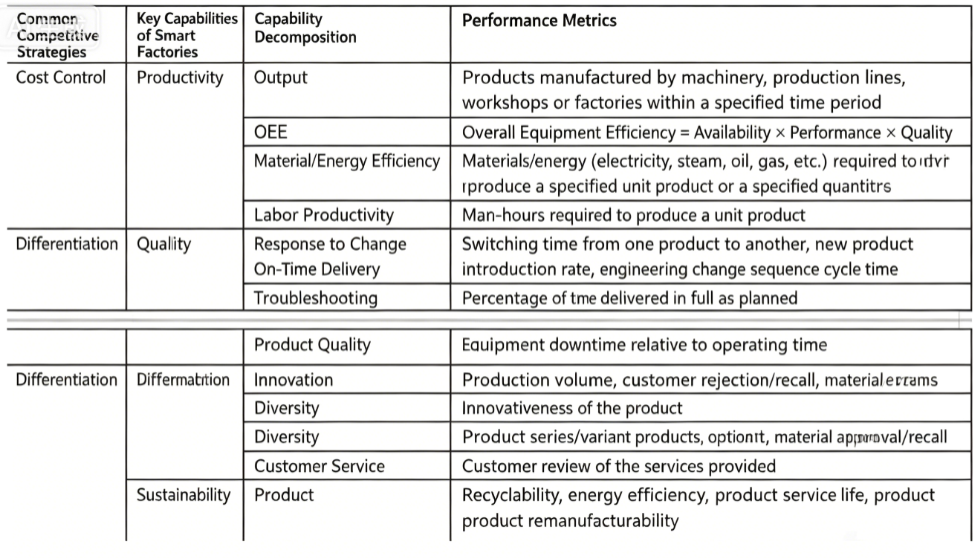
Performance Index Requirements of Smart Factories
2. The Role of Automation
Traditionally, automation is only interpreted from the perspective of the automation industry, covering sensor detection, control loops, data display and trend alarming. But when placed within the broader context of smart manufacturing, automation serves the core essence of business operations.
① Guarantee Operational Efficiency
What is the purpose of automation? In conventional production operations, manual handling and machining cannot match the operating speed of machinery. Especially for integrated smart manufacturing production lines, automation eliminates unnecessary intermediate non-value-added activities defined in lean management. When we talk about digitalization in discrete manufacturing today, continuous process manufacturing already boasts a far higher level of automation.
② Secure Production Quality
High-precision servo positioning, synchronous control and integrated robotic manufacturing continuously improve product quality and consistency — advantages machines hold over manual labor.
③ Deliver Production Flexibility
Motion control not only delivers high-precision machining quality but also ensures production agility. On all types of equipment, motion control enables flexible manufacturing: servo systems generate machining trajectories via parameter configuration to achieve smooth process changeovers.
④ Collect Upstream Data and Execute Downstream Commands
Automation systems also underpin lean visual management, including trend monitoring and alarming. They transmit energy, maintenance and quality production data to higher-level management systems, while receiving execution instructions such as new order machining parameters and process sequences from those systems.
3. The Role of Digitalization & Informatization
Automation has enabled highly standardized mass production. However, surging personalized production demands create new hurdles, bringing challenges to lean targets of quality, cost and delivery.
From an operational standpoint, smart manufacturing relies on full information transparency for problem analysis. Connected data delivers a holistic view of production lines to identify operational optimization opportunities.
Data collection at the manufacturing floor has long been challenging due to vertical industry differences. This issue has become prominent in recent smart manufacturing projects and created major implementation barriers, which explains why OPC UA has gained widespread popularity.
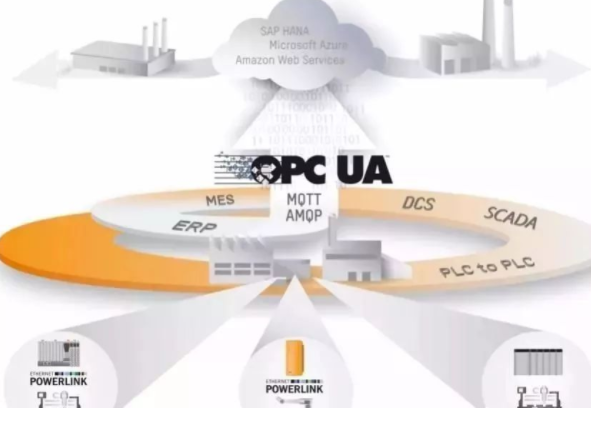
Manufacturing Information Integration Based on OPC UA / MQTT
OPC UA delivers communication and device-layer specifications, while data dictionaries define information modeling standards at the management level. Within the RAMI 4.0 reference model, the Administration Shell and data dictionaries together establish unified global information standards and models for business processes. This realizes horizontal information integration across the manufacturing value stream.
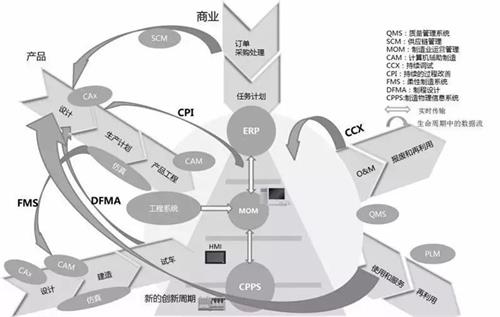
Reference of Standard System Architecture for Smart Manufacturing
4. Intelligence — Global Optimization and Decision Support
Automation focuses on regulating individual control tasks; even multi-variable systems are generally confined to a single machine or a standalone subsystem (such as refining and pharmaceutical production processes). In contrast, global production optimization operates on a higher dimensional level, where the required computing power and modeling capabilities exceed the limits of conventional mechanism-based models.
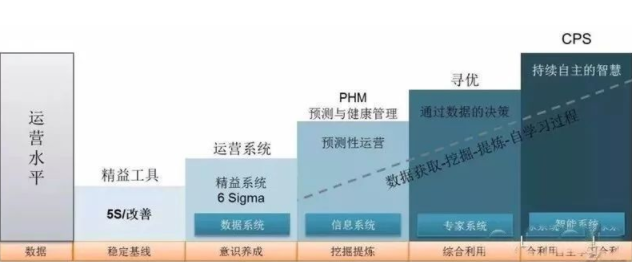
Hierarchical Stages from Lean Production to Intelligent Operations
This diagram fully illustrates the complete evolution path from lean manufacturing to intelligence, covering data collection, information processing, cross-domain data utilization, and ultimately autonomous learning capability.
To sum up, intelligence is a system-wide optimization built upon lean operations, automation and informatization. Leveraging comprehensive models, it realizes full collaboration spanning market demand pull, process design & auxiliary manufacturing, supply chain (covering conventional supply chains as well as smart power grids and logistics), production & manufacturing, and operation & maintenance. It conducts overall optimization calculations based on equipment status, production orders, energy consumption, financial costs and other multi-dimensional data, so as to provide decision support for enterprise operations.
Knowledge-Based Talent Cultivation — An Indispensable Topic
We have discussed the evolution of smart manufacturing rooted in lean production, yet we also need to address the linkage between knowledge inheritance and talent development, which is equally critical to smart manufacturing.
1. Knowledge Reuse — Reusable Intellectual Assets
Human beings constitute the most vital link across the entire manufacturing workflow. From continuous lean improvement, mechanical design for automated control, informatization construction to intelligent model training, human expertise is extracted and standardized into reusable specifications. Such knowledge can be repeatedly utilized by digital systems and continuously updated via self-learning to support optimized decision-making.
Not only software modules can be reused; human know-how and experience must also be reproduced. Tangible raw materials and intangible time are both resources, while human wisdom and experience represent an even more valuable asset with tremendous cost-performance potential.
2. Talent Training & Education as the Foundation of Smart Manufacturing
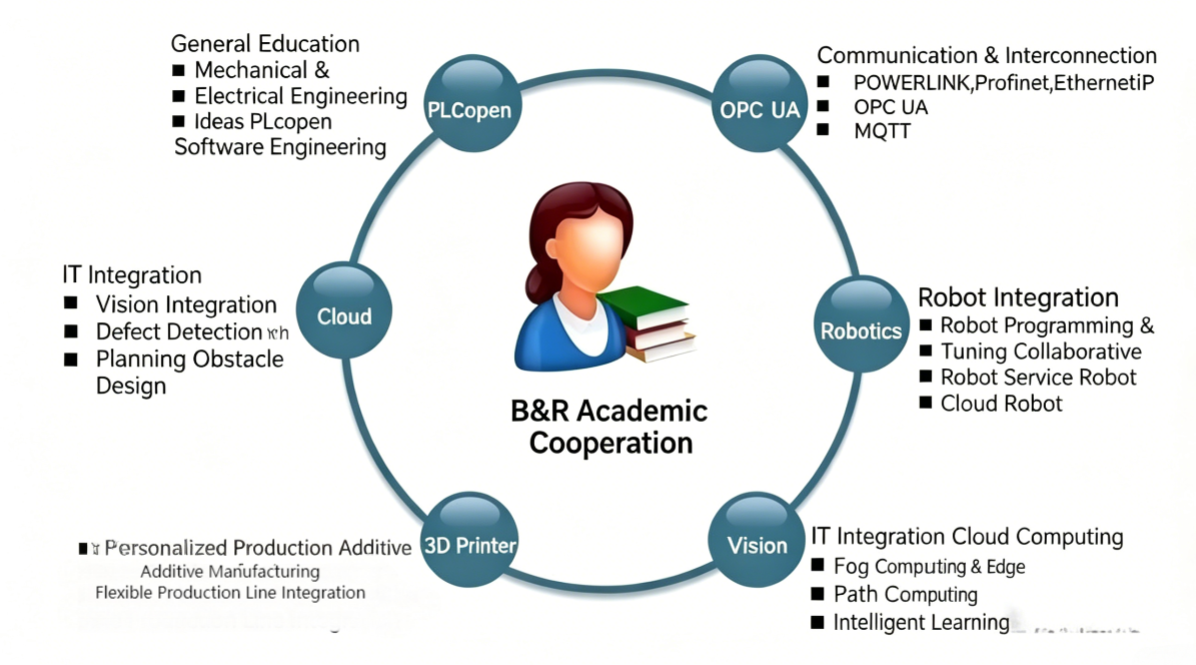
Talent development lies at the core of smart manufacturing. The prevalent fragmented understanding of smart manufacturing today stems from insufficient systematic and holistic thinking training in education. Specifically, smart manufacturing requires interdisciplinary technical training: automation practitioners need to expand their expertise into information technology and mechanical engineering, while learning robotics, industrial communication, and PLCopen software development methodologies.