







"Open Competition Mechanism for Selecting Top R&D Teams" — New Progress Achieved in Development of Silicon Alloy Casthouse Working Robots
Beijing Lapsen Intelligent Technology Co., Ltd. (hereinafter referred to as Lapsen) has cooperated with Ordos Xijin Mining & Metallurgy Co., Ltd. to develop taphole operation robots for silicon alloy submerged arc furnaces based on Ordos’ Open Competition Mechanism for Selecting Top R&D Teams project.
To date, the project has achieved the latest research results. The development of robot bodies for automated smelting operations of submerged arc furnaces has been completed, producing 1 design report and 3 operation manuals, as well as acquiring 2 patents. The pilot test verification of the first complete set of equipment has also been carried out ahead of the scheduled progress. No similar robot equipment has been applied in the ferrosilicon industry, marking a leading technical edge in the sector.
The development project of taphole operation robots for silicon alloy submerged arc furnaces targets 25500kW, 36000kW and 45000kW ferrosilicon submerged arc furnaces as application carriers. It researches fault-tolerant control methods for production processes under harsh high-temperature environments, designs cluster robot operation workflows covering taphole tapping, rodding and tap-hole plugging at the furnace front, deploys physical prototypes of tapping robots and conducts application verification and demonstration. All research contents of the project fully cover the scope of required technical breakthroughs.
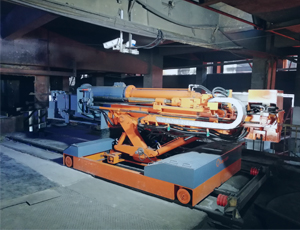
(Prototype Trial Production of the First Taphole Operation Robot for Silicon Alloy Furnaces)
Manual labor is widely adopted for taphole operations of high-silicon alloy furnaces, which comes with a high level of work safety risks. In response to national requirements for advanced technologies in the submerged arc furnace industry, robots are deployed to replace manual work to realize automated and intelligent execution of tapping, rodding and tap-hole plugging. This drastically cuts down the number of on-site furnace operators, mitigates safety hazards, lifts production efficiency and reduces manufacturing costs.Large-scale adoption of robotic operations represents an inevitable trend in the technological and equipment advancement of submerged arc furnace smelting, and also charts the course for the industry to develop toward green, automated, intelligent and safe production.
(Trial Prototype Design Scheme for the First Silicon Alloy Furnace Taphole Operation Robot)
In the next step, we will further tap into the operational efficiency of the robots, expand the outcomes of pilot applications, and complete the demonstration operation of taphole operation robots matched for all tapholes of a single furnace, laying a solid foundation for the full promotion and application of silicon alloy furnace taphole operation robots.
Founded in 2014, Lapsen Technology is headquartered at Pingqian Industrial Park, Wujiang District, Suzhou. It comprises Suzhou Lapsen Intelligent Technology Co., Ltd., Beijing Lapsen Intelligent Technology Co., Ltd., and Beijing Lapsen Energy and Environmental Protection Technology Co., Ltd. As a high-tech enterprise, it specializes in hazardous-environment robots and smart factory solutions.
The company boasts domestically leading independent design and development capabilities for hazardous-environment robot equipment. Lapsen and its subsidiaries hold a variety of intellectual property rights, and have built close cooperative ties with well-known domestic universities and key research institutes such as the Institute of Automation, Chinese Academy of Sciences, Tsinghua University and University of Science and Technology Beijing. Lapsen Technology focuses on the R&D of industrial robots for heavy industries, which are mainly deployed in high-risk working environments involving heavy labor, high altitude, high temperature, heavy dust and toxic hazards across industries including calcium carbide chemical, iron & steel metallurgy, ferroalloy smelting, industrial silicon smelting, chemical raw materials, building materials, alumina and PVC.