







Advancements in industrial robots and automation industries largely rely on machine vision.
We have entered the Industry 4.0 era. Manufacturing has evolved from manual operation in the early days to automation and intelligence as mainstream production modes today. The rapid advancement of industrial robots has enabled the widespread adoption of machine vision technology. This has accelerated the progress of industrial automation and driven growth across all industrial sectors. Next, let’s take a closer look at the evolution and breakthroughs of machine vision.
Machine vision has a development history of more than 20 years and essentially constitutes an important branch of computer science. In the 1950s, research focused on simple statistical pattern recognition of two-dimensional images. In the 1960s, scholars began to explore three-dimensional machine vision. From the mid-1970s to the early 1980s, research on machine vision was carried out extensively worldwide. Meanwhile, the MIT Artificial Intelligence Laboratory launched specialized courses on machine vision, ushering in a period of vigorous development for this technology.
The vision technologies applied today all fall under the third-generation robotic vision systems. Equipped with high-speed image chip processing algorithms, they deliver superior intelligence and adaptability and can simulate human visual capabilities.
Machine vision systems mainly consist of three core components:
1.Robotic eye structure
The robotic eye functions like a camera or scanner. It emits infrared light through infrared transmitters, which bounces back after hitting target objects. After receiving the reflected infrared rays, infrared receivers convert optical signals into electrical signals and transmit them to the chip. The chip conducts comprehensive calculations via specific algorithms to identify the position, shape and other features of objects.
2.Motion control system
As one of the core components of industrial robots, the control system exerts a decisive impact on robot performance, and motion control itself is a subfield of automation. Driven by servo devices such as hydraulic pumps and linear actuators or motors, it regulates the position and moving speed of equipment. With continuous advances in robotic technology, robots now achieve extremely high precision and speed.
3.Image processing
Raw images must undergo image processing to extract target features, which enables subsequent execution of commands such as robotic arm movement to complete assigned tasks.
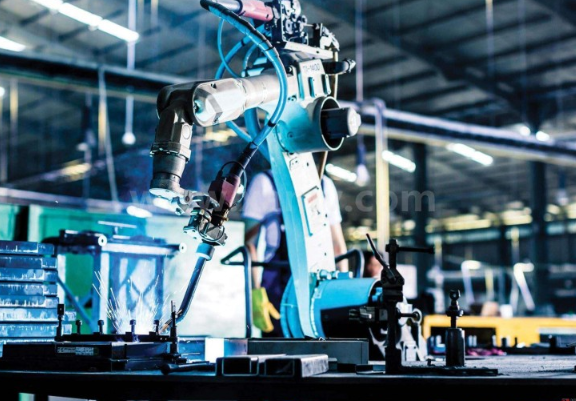
In industrial scenarios, machine vision is widely deployed in industrial robot workflows including production, assembly and handling.
Machine vision covers diversified applications
Machine vision is far from a single-purpose technology. It endows equipment with "eyes" to perceive the external environment and replicates human visual capabilities to realize various functions such as detection, judgment, identification and measurement. At present, hardware and software products for machine vision have become indispensable across all stages of product manufacturing, which raises higher standards for system integration.
Many automation enterprises require integrated production automation systems that coordinate machine vision with various industrial equipment such as industrial robots. It is widely adopted in condition monitoring, finished product inspection, quality control and many other fields. As technology evolves, the visual capability gap between robots and humans keeps narrowing. The maturation of vision technology has expanded its application scope in industrial manufacturing.
In the future, machine vision technology will be integrated with other sensor technologies and become increasingly digital and intelligent.
Conclusion
Made in China 2025 is closely bound up with machine vision. Machine vision technology will undoubtedly become one of the core pillars of industrial automation and intelligence in the future. To extend human visual perception onto robots, systems must feature high automation, high efficiency, high precision and strong adaptability, which plays a crucial role in industrial automation.
Source: Information Technology and Software Service Network