







5G Empowers Flexible Manufacturing and Delivers New Opportunities for Manufacturing Transformation and Upgrade
Countries across the globe have come to recognize the vital role of cutting-edge technologies in manufacturing and taken proactive steps to make strategic layouts in relevant fields. At present, the adoption of information technologies including 5G and artificial intelligence has unlocked new growth opportunities for the manufacturing industry.
Driven by the digital revolution, the integration of new-generation information and communication technologies such as big data, cloud computing and AI with manufacturing has evolved from theoretical promotion to large-scale practical deployment. The manufacturing sector is witnessing an increasingly distinct shift toward intelligence, flexibility, service orientation and high-end development, resulting in mounting urgent demand for high-performance wireless networks with flexible networking functions.
2019 marked the first year of large-scale 5G commercial deployment. Boasting fiber-equivalent transmission speeds, pervasive connectivity for all types of devices, and real-time performance comparable to industrial field buses, 5G is gaining deeper traction across industrial sectors. It has spurred a wide array of integrated innovative applications and industrial transformations, delivering historic development opportunities for the transformation and upgrading of manufacturing industries.
I. 5G Empowers Flexible Production Lines
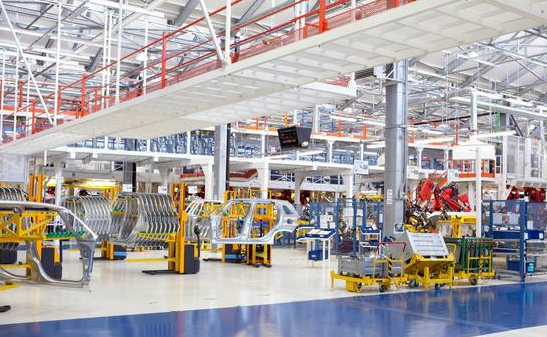
A flexible production line can dynamically adjust manufacturing schedules in response to fluctuating orders, serving as the core foundation for diversified, personalized and customized production. Under traditional network architectures, despite relatively mature modular design for individual production units, manufacturers face substantial constraints during mixed-model production due to physical limitations on cabling and network deployment. 5G empowers flexible production lines in two key dimensions.
First, it enhances flexible deployment capabilities of production lines. Manufacturing modules on future flexible lines demand rapid reconfiguration at low retrofitting costs. With 5G deployed across factories, shop-floor equipment is freed from wired cables. Wireless connectivity to cloud platforms enables fast function updates, free movement, splitting and recombination of machinery, allowing flexible line transformation within a short timeframe.
Second, it delivers elastic network deployment via SDN, NFV and network slicing embedded in 5G architecture. Manufacturers can flexibly orchestrate network architectures tailored to diverse business scenarios, build exclusive transmission networks on demand, and allocate network resources according to differentiated transmission requirements. Through bandwidth throttling and priority configuration, 5G delivers customized network control and guaranteed performance for each production stage. Under this framework, production workflows can be rearranged alongside changes in raw material supplies and customer orders, with corresponding adjustments made to inter-device networking and communication links.
II. 5G Empowers Cloud-Based Robots
Cloud-based robots are defined by a cloud control platform that leverages AI, big data and other advanced technologies to command on-site robots to execute tasks. Such robots require massive real-time data exchange with cloud platforms, which relies on wireless communications featuring high throughput, ultra-low latency and ultra-high reliability. 5G unlocks three core capabilities for industrial cloud robots.
For one thing, it boosts multi-robot collaboration. 5G delivers high-speed inter-robot communications, enabling self-organization and cooperative operation. Robots can work in tandem to accomplish complex tasks impossible for a single unit alone. In addition, lead robots with superior authority can command fleets of execution robots via 5G to complete assignments efficiently.
For another, it enables agile and safe human-robot collaboration. 5G’s ultra-high reliability and minimal latency allow robots to perceive human operators’ motions in real time, respond dexterously while maintaining constant safe separation distances to secure human-machine interaction.
Third, it supports real-time remote robot control. In harsh environments such as high-temperature and high-pressure workshops inaccessible to workers, operators can remotely manipulate robots synchronously from monitoring centers via 5G to safely fulfill production targets.
III. 5G Empowers Industrial AR/VR
Industrial AR will be widely adopted for assembly guidance and equipment maintenance, overlaying virtual graphics onto real-world views to visualize operational steps, cutting engineers’ working hours and error rates. Industrial VR facilitates collaborative industrial design by connecting remote personnel within a shared virtual space, and supports 3D virtual factory visualization for managers to gain a holistic overview of production status. Ultra-high-definition AR/VR streams generate over hundreds of megabits of data per second, while existing 4G and Wi-Fi networks struggle to simultaneously deliver stable, smooth and low-latency visual experiences. 5G advances industrial AR/VR in three aspects.
Firstly, it enables lighter, more affordable AR/VR terminals. Factory environments are complex and dynamic, requiring AR/VR hardware to be highly portable. 5G-based cloud AR/VR offloads data-intensive computing tasks to remote cloud servers, leaving only connectivity and display functions on local devices, significantly reducing terminal weight and manufacturing costs.
Secondly, it elevates display quality for industrial AR/VR. 5G’s high throughput and massive connection capacity support mass data transmission of high-definition AR/VR visuals, boosting frame smoothness and image clarity. It meets extreme display requirements including 8K resolution and 3D rendering, delivering intricate visual effects and immersive user experiences.
Thirdly, it optimizes interactive performance of industrial AR/VR. The evolution of industrial AR/VR centers on real-time interaction between users and virtual/physical environments. 5G satisfies millisecond-level latency demands for highly interactive use cases such as remote multi-party collaborative design and virtual factory operation training, enhancing interaction between users and digital/physical environments.
IV. 5G Empowers Real-Time Data Collection and Monitoring
Within smart factories, gathering production data and monitoring workshop operating conditions and equipment health are critical foundations for production decision-making, scheduling and maintenance. Although wireless technologies such as NB-IoT and Zigbee have seen partial adoption for industrial data acquisition and supervision, each suffers inherent drawbacks in transmission rate, coverage, latency, reliability and security. 5G addresses these limitations through three core strengths.
To begin with, it supports real-time mass data uploading across factories. 5G’s massive connectivity and low latency interconnect vast volumes of production equipment and key components on-site, improving timeliness of data collection to underpin production workflow optimization and energy management. Meanwhile, numerous environmental sensors transmit temperature, humidity, illumination, air quality and pollution readings to management systems instantaneously via 5G, enabling precise workshop environmental regulation.
Furthermore, it facilitates ultra-high-definition video surveillance and machine vision recognition. 5G streams high-resolution surveillance footage back to central control rooms, reconstructing fine-grained production details via 5G+8K ultra-HD video to enable refined factory supervision. Machine vision applications including product defect detection, precision raw material identification and high-precision measurement demand real-time transmission of high-volume high-resolution images, which 5G reliably delivers to accelerate detection speed and boost recognition accuracy.
Lastly, it strengthens remote full-lifecycle equipment maintenance. 5G’s wide coverage, massive device support, low cost and low power consumption enable continuous real-time monitoring of production assets throughout their service lives. Maintenance workflows are no longer confined within factory boundaries, allowing cross-site and cross-regional remote fault diagnosis and equipment repair.
Conclusion
As a next-generation wireless communication technology, 5G delivers diversified, high-quality communication guarantees for smart manufacturing systems and integrates massive data flows across all production links. As deeper integration between 5G and manufacturing unfolds, transformative impacts will extend beyond process optimization — including enhanced controllability, elevated operational efficiency, lower production and energy costs — and accelerate the widespread adoption of revolutionary new products, technologies and business models in manufacturing. It is foreseeable that the “5G+” era will drive comprehensive, in-depth intelligent upgrading of the manufacturing sector. Integrated innovation centered on 5G will serve as a powerful engine and robust underpinning for high-quality development of China’s manufacturing industry.
Source: Informatization and Software Service Network