








Analysis: Pain Points and Challenges in the Transformation of Traditional Manufacturing Industries
Against the backdrop of major shifts in the global industrial competition landscape, smart manufacturing has emerged as a major trend and core pillar of manufacturing development. The adoption of information technologies such as artificial intelligence and the Internet of Things has further fueled the transformation of traditional manufacturing sectors, steering them toward automation and intelligence.
The manufacturing industry is now standing at the forefront of new development and reform, with smart manufacturing serving as the core vehicle for overhauling industrial value chains.
Spurred by continuous breakthroughs in IoT, artificial intelligence, big data, cloud computing and other technologies, coupled with the implementation and industrial reshaping brought by Industry 4.0, a growing number of enterprises are speeding up their intelligent transformation. Nevertheless, most companies remain at the preliminary maturity stage in smart manufacturing capacity building, and are confronted with widespread confusion and challenges as they deepen relevant deployment.
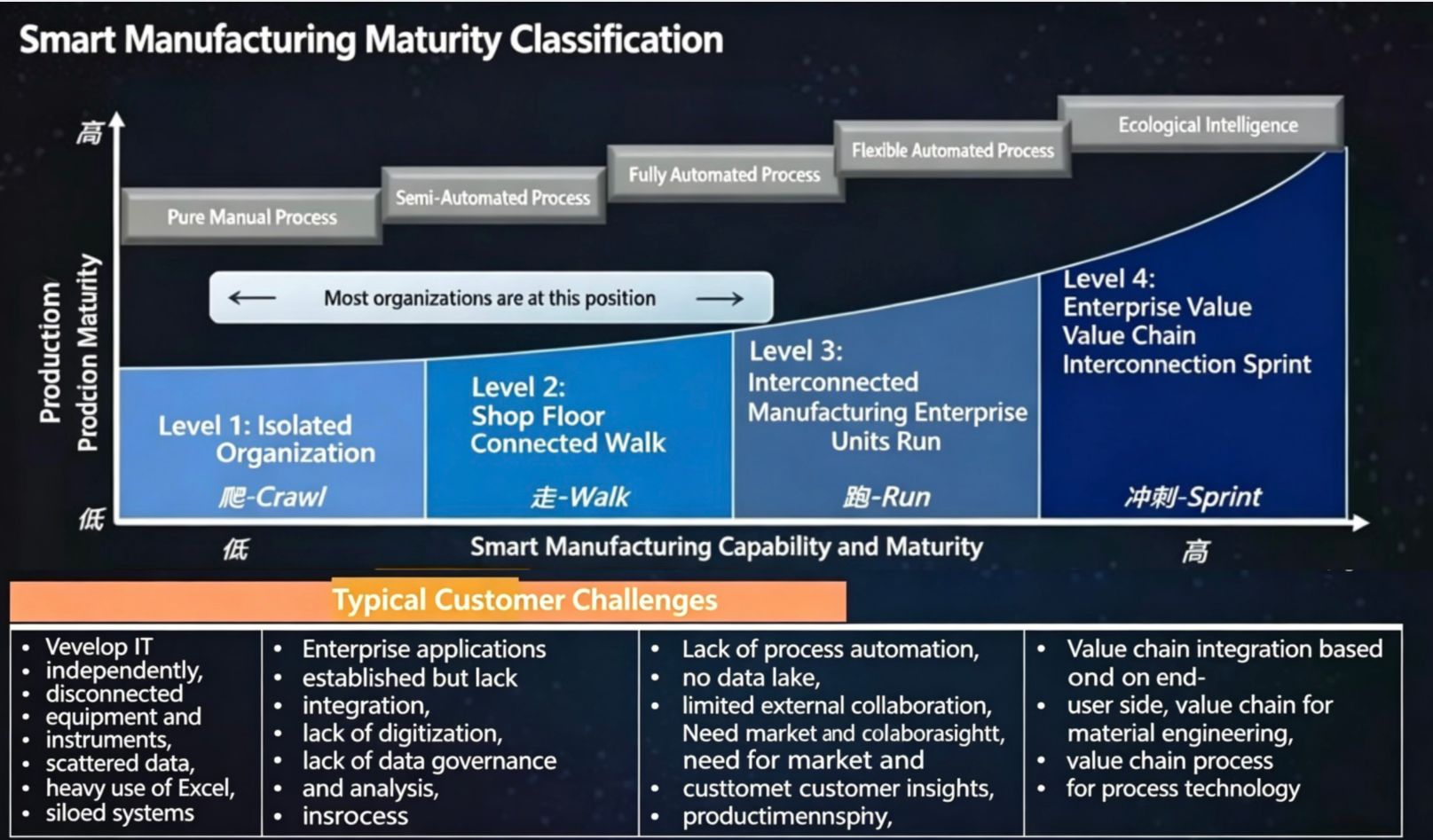
Figure: Maturity Classification of Smart Manufacturing
To achieve successful digital reshaping, enterprises must fundamentally rethink their operational models as well as how they interact with the industrial ecosystem. Nevertheless, manufacturing companies still face numerous pain points across supply chain management, manufacturing collaboration, process control and other links during their transition toward automation, intelligence and digitalization. Only by accurately identifying internal management bottlenecks can enterprises formulate scientific improvement solutions.
Challenges Faced by Traditional Manufacturers in Transformation and Upgrading
1. Lack of Effective Cross-Department Collaboration
As enterprises expand to a certain scale, high individual efficiency often fails to translate into high organizational efficiency. A typical scenario is that shop-floor workers remain fully occupied, yet urgent orders cannot be delivered on schedule while non-urgent finished goods pile up in warehouses.
In addition, departments operate in silos without unified coordination, frequently shifting blame and passing the buck to one another, which undermines overall corporate profitability.
2. Unstable Production Performance
China’s manufacturing sector is dominated by small and medium-sized enterprises (SMEs), most of which serve as supporting suppliers for large corporations, trapping them in the mid-to-low end of industrial chains. Key destabilizing factors are as follows:
(1) Volatile Order Backlogs
Unlike large high-end industrial players that can conduct accurate volume planning based on sales forecasts and market analysis, SMEs are constantly subject to rush order insertions, order revisions, additional orders and order cancellations, leaving them in a passive position for demand forecasting.
(2) Fragile Supply Chains
Driven by fluctuating orders and cost pressures, most SMEs maintain unstable supply chains, with suppliers largely consisting of small workshops, family-run stores or small partnership factories. Maximizing overall supply chain efficiency therefore becomes extremely challenging.
(3) Erratic Production Processes
Low automation levels and lengthy process workflows frequently trigger abnormalities in equipment performance, product quality, raw material supply and labor scheduling across traditional manufacturers. Unstable production processes stand as the most persistent and troublesome pain point for most enterprises.
3. Severe Shortages of Foundational Production Data
Many enterprises have accumulated partial operational data and deployed ERP systems over years of development, yet the authenticity and integrity of their data leave much to be desired, rendering it incapable of guiding actual production. This is a core reason behind failed ERP implementations. SMEs primarily lack three categories of core production documents:
(1) Incomplete Technical Documentation
Enterprises suffer from poor archiving of technical parameters and incomplete technical files. For instance, Bills of Materials (BOMs), the fundamental documents defining product component structures, are often inaccurate in many factories.
(2) Missing Process Specifications
Most SMEs lack standardized process documents such as work instructions and process flowcharts for corresponding products. Production operations rely entirely on the personal experience of on-site supervisors.
(3) Inaccurate Warehouse Production Records
The consistency rate of warehouse accounts, physical inventory and inventory labels remains extremely low in numerous enterprises. As the core hub for pre-production material preparation, incomplete warehouse data creates massive obstacles to production management.
4. The Three "Mute" Dilemma
A great number of SMEs are plagued by the so-called Three Mute Problems: mute workstations, mute equipment and mute enterprises.
The term "mute" refers to workstations, machinery and entire factories that remain disconnected from digital networks, unable to auto-report operational data or support transparent management. It vividly depicts a state where information cannot be exchanged, shared or visualized.
For traditional manufacturers to shift from conventional manufacturing to smart manufacturing, technical and equipment upgrades must be paired with solutions to the Three Mute Problems.
It is essential to enable real-time information exchange and sharing across workstations and equipment, alongside full-process real-time monitoring and quality control covering raw material intake through finished goods packaging and warehousing. Production systems must deliver instant progress feedback, automatically collect equipment and inspection data, and autonomously judge product conformance. The system triggers alarms for defective products to prevent flawed items from being packaged and shipped to market.
5. Imperfect Talent Pipeline Development
Most supervisors are skilled technicians promoted from frontline workers alongside corporate growth, with no formal professional management training and limited awareness of digitalized information management. Meanwhile, on-site workshop staff have uneven professional literacy, making it difficult to implement advanced production management methodologies including lean manufacturing and Just-in-Time (JIT) production.
二、Three Entry Points for Smart Manufacturing
Given the numerous pain points plaguing traditional enterprises in production and operation, targeted improvements are mandatory when rolling out smart manufacturing to deliver tangible business benefits. IBM identifies three core entry points for implementing smart manufacturing: lean production, manufacturing collaboration and integrated operations.

1. Lean Production
Lean production is a production management methodology that transforms system architecture, personnel organization and operational modes. It enables production systems to rapidly adapt to evolving customer demands, eliminates all defects and redundant elements throughout production workflows, and ultimately optimizes comprehensive indicators covering production efficiency, product quality and customer feedback.
2. Manufacturing Collaboration
Based on a unified information system architecture, manufacturing collaboration adopts integrated concepts and methodologies to interconnect all subsystems, breaking down information silos prevalent in the manufacturing industry. Supported by visualized platforms that deliver real-time visibility of production status, it strengthens cross-department collaborative production management capabilities within enterprises.
3. Integrated Operations
In integrated operation, real-time agile supply chain collaboration lifts overall operational efficiency. Predictive quality systems shift quality management from post-inspection to pre-prevention. Manufacturing-oriented shared platforms connect customer demands and system resources seamlessly to boost corporate customer response capacity.