






Intelligent manufacturing is the core priority of Made in China 2025.
The "intelligence" in the term "intelligent manufacturing" can be interpreted from two dimensions: wisdom and capability. The core connotation of wisdom lies in knowledge, while capability refers to the ability to acquire knowledge and apply it to solve practical problems.
Gottfried Wilhelm Leibniz, a German mathematician and philosopher, argued that human rational thinking is a form of computation. He devoted himself to studying human thought processes through formal mathematical methods. In 1674, he demonstrated an arithmetic calculator capable of four fundamental arithmetic operations at the Paris Academy of Sciences. Prior to this invention, computation was regarded as an intelligence exclusive to human beings.
The steam engine that triggered the First Industrial Revolution was initially operated manually. Stable running speed and regulated acceleration and deceleration entirely relied on the operator’s experience. After scientists uncovered the working principle of steam engines and invented the centrifugal governor for automatic speed regulation, steam engines could adjust their operating speed autonomously. In a sense, the machine was endowed with the speed-regulation experience that once belonged only to humans.
Early manual machine tools relied on operators’ superb skills and experience to machine curved surfaces. In contrast, numerical control (NC) machine tools invented in the 1950s realized automatic machining of complex curved surfaces. NC machine tools outperformed the accumulated skills and experience of senior technicians and broke through bottlenecks in processing complex parts.
On May 11, 1997, the supercomputer Deep Blue defeated Garry Kasparov, the world chess champion, making it the first machine to beat a human grandmaster in international chess. Before this landmark event, logical reasoning was considered a uniquely human intelligence. In March 2016, AlphaGo, an artificial intelligence program, competed against Lee Sedol, a 9-dan professional Go world champion, and won the match with a total score of 4 to 1, marking another milestone in the history of artificial intelligence.
These technological breakthroughs reveal an underlying law in the research of intelligent science and technology: intelligent science evolves continuously. Whenever scientists establish a mathematical model for a certain human intelligence based on in-depth research, and develop algorithms or devices to replicate such intelligent functions, this specific human intelligence becomes materialized within machinery, pushing intelligent technology to new heights.
China launched research on the theories and technologies of intelligent manufacturing almost concurrently with developed countries in the 1980s and has achieved remarkable progress. The National Natural Science Foundation of China has successively funded key and major research projects related to intelligent manufacturing, while the Ministry of Science and Technology has initiated relevant National Basic Research Program of China (973 Program) projects.
Intelligent manufacturing aims to endow manufacturing equipment and systems with intelligence. Its core research covers information perception and analysis, knowledge representation and learning, as well as intelligent decision-making and execution throughout manufacturing activities (the closed loop of Perception – Learning – Decision-making – Execution). Intelligent manufacturing technologies cover manufacturing links across the full product lifecycle, including design, production, management and after-sales service. Its technical system mainly consists of manufacturing intelligence technology, intelligent manufacturing equipment technology, intelligent manufacturing system technology, and intelligent manufacturing service technology.
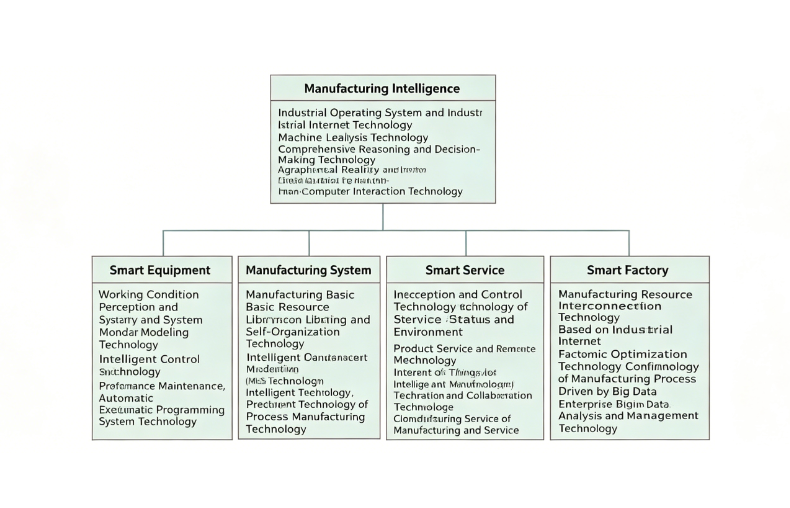
Intelligent Manufacturing Technology System
Intelligent manufacturing serves as a vital vehicle to materialize the attributes and functions of knowledge, with its ultimate goal of continuously enhancing the intelligence of manufacturing equipment and systems. Manufacturing covers an extensive array of knowledge domains, and human understanding of manufacturing theories keeps deepening and expanding. Therefore, intelligent manufacturing will evolve perpetually, and its definition will be continuously updated and enriched as technology advances.
Since the start of the 21st century, a new round of technological revolution and industrial transformation has been brewing. Global scientific and technological innovation has taken on new trends and characteristics. Centered on intelligent manufacturing, information technology, biotechnology, new material technology and new energy technology have penetrated all industries, triggering a cluster technological revolution featured by intelligence, service-orientation and green development across nearly all sectors — this marks the new industrial revolution.
Intelligent manufacturing, namely the digitalized, networked and smart transformation of manufacturing industry, acts as the core technology of the new industrial revolution.
First, it propels mechanical products to evolve into the "numerically-controlled generation" and further the "intelligent generation", fundamentally upgrading product functions, performance and market competitiveness.
Second, it drives manufacturing toward integrated digital, networked and intelligent production, comprehensively elevating capabilities in product design, production and management.
Third, it fosters the transformation and innovation of industrial models: shifting from mass assembly-line production to mass customized production; transforming production-oriented manufacturing into service-oriented manufacturing; and creating the integrated model of "Internet + advanced manufacturing + modern service industry".
At present, intelligent manufacturing has become a core competitive battlefield among major manufacturing powers. Countries including the United States, Germany and Japan have successively launched research initiatives and deployed industrial strategies for intelligent manufacturing, taking the lead globally in this industry. In 2015, intelligent manufacturing was designated as the core priority of Made in China 2025. Guided by the integration of industrialization and informatization, the strategy prioritizes the development of intelligent equipment and intelligent products, advances the intelligentization of production processes, cultivates new production modes, and comprehensively boosts enterprises’ intelligent capabilities in R&D, production, management and service.
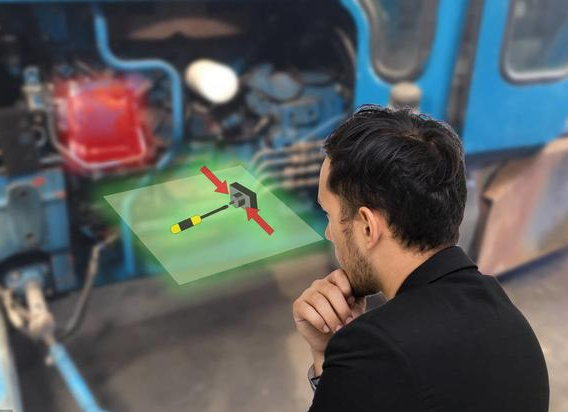
To carry out the Intelligent Manufacturing Project, we shall closely focus on key links in core manufacturing sectors, conduct integrated innovation and engineering application based on the deep integration of new-generation information technology and manufacturing equipment. We will support joint research among enterprises, universities, research institutes and end users to develop intelligent products and independently controllable intelligent devices and realize their industrialization. Relying on leading enterprises, we will build smart factories and digital workshops in key sectors by targeting intelligent transformation of key working procedures, robot replacement for key posts, intelligent optimized control of production processes and supply chain optimization.
We will launch categorized pilot demonstrations and promote the application of process manufacturing, discrete manufacturing, intelligent equipment and products, new business forms and models, intelligent management and intelligent services in key regions, industries and enterprises with sound basic conditions and urgent market demands. We will establish a standard system for intelligent manufacturing and an information security guarantee system, and build a network platform for intelligent manufacturing.
China is currently accelerating the development of its intelligent manufacturing industrial system. Nevertheless, as China has not yet completed industrialization, a large number of enterprises are still in the stage of automation upgrading, resulting in a relatively underdeveloped intelligent manufacturing industry. High-end CNC machine tools, industrial robots, additive manufacturing equipment (3D printing equipment), intelligent sensing and control devices, intelligent testing equipment, as well as intelligent logistics and warehousing equipment are the core intelligent manufacturing equipment within the industrial system, whose performance determines the development level of the entire industrial chain.
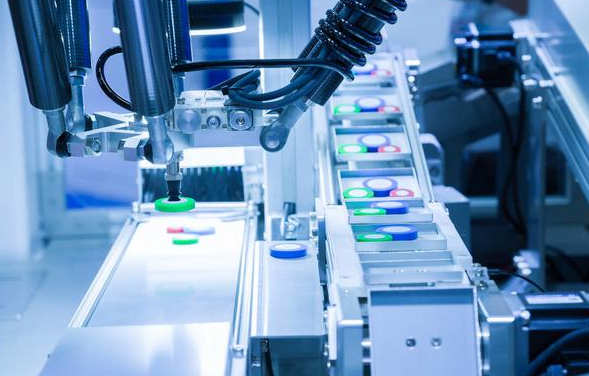
Industrial Robots:China has fostered a number of robot enterprises with initial scale, and certain special-purpose robots have reached world advanced standards. Nevertheless, high-end general-purpose robots still rely heavily on imports. Core technologies for key components such as controllers, motors, servo drive units and sensors are predominantly held by international industrial giants including ABB (Switzerland), KUKA (Germany) and YASKAWA (Japan).
CNC Machine Tools:China has made breakthroughs in key technologies for some special-purpose machine tools, such as intelligent double-sided lathes for machining aero-engine compressor disks. However, high-end general CNC machine tools still need to be imported from industrial powers like the United States, Japan and Germany. There remains a noticeable performance gap between domestic and foreign advanced products in core components including numerical control systems, motors, servo drive units, spindle motors, precision linear encoders and cutting tools.
Additive Manufacturing Equipment (3D Printing Equipment):China has achieved technological breakthroughs in 3D printing for large aerospace components, yet a complete supporting industrial chain has not yet taken shape. The United States boasts world-leading R&D capabilities for metal materials used in 3D printing. France, Germany and Belgium in Europe host technically competitive 3D printing enterprises that have realized digital mass production.
Intelligent manufacturing represents the in-depth integration of informatization and industrialization. Key enabling technologies supporting intelligent manufacturing cover a broad spectrum: diverse sensing technologies, knowledge extraction technologies based on sensor data (machine learning, big data analytics, etc.), reasoning and decision-making technologies, intelligent control technologies, industrial operating system technologies, Industrial Internet, Internet of Things, Internet and mobile Internet technologies, as well as next-generation human-machine interaction technologies.
Manufacturing of the future will feature full-dimensional perception. Sensors deployed across products, production systems, warehousing and logistics, and management platforms can capture real-time data on product operating performance and customer conditions, production status, and the storage and transportation of raw materials and finished goods.
Manufacturing of the future will be fully digitalized. Digitalization will be realized across product design, production workflows, warehousing and logistics, customer services and production management.
Manufacturing of the future will be network-connected manufacturing. All sensors, controllers and other hardware embedded in products, production systems, warehousing logistics and management systems are interconnected via networks. This architecture enables full-lifecycle monitoring of products, driving optimized production workflows and upgraded customer services.
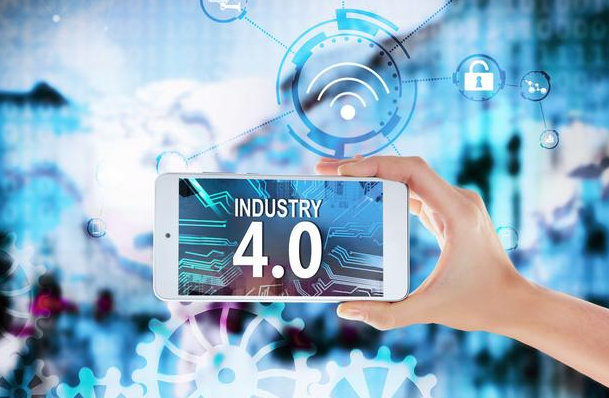
Manufacturing in the future will be wisdom-driven manufacturing. Supported by mathematical models and intelligent algorithms, products, production systems, warehousing & logistics systems and management systems can optimize their own operation based on sensor data, conduct self-diagnosis, self-maintenance and self-learning, and achieve global coordination and optimization through interconnection and interaction.
The above characteristics of intelligent manufacturing can keep design, production, management and service systems operating at optimal status, cut energy consumption and raw material consumption, and realize green manufacturing. It enables enterprises, R&D personnel and makers scattered all over the world to share open resources via the Internet and realize shared manufacturing. It allows product suppliers to gain real-time and comprehensive insights into product operating conditions and customer experience, thus realizing service-oriented manufacturing. It endows production processes with rapid reconfiguration and quick response capabilities to deliver customized manufacturing for customers. It realizes fully-connected manufacturing by enabling interconnection among products, equipment, end users and production managers.
Intelligent manufacturing boasts broad development prospects and tremendous opportunities. Guided by major national strategic demands, the development of intelligent manufacturing will focus on tackling core key technologies to fuel the growth of China’s manufacturing industry.
Source: Information Technology and Software Service Network