






"Data + Computing Power + Algorithms" — Core Technologies of Intelligent Manufacturing
The evolution and progress of the era have always been accompanied by passionate innovation and unpredictable subversion. In recent years, with the rapid advancement of big data, cloud computing, artificial intelligence, industrial Internet and other digital technologies, digital techniques have been widely applied in all links of the manufacturing industry, accelerating the arrival of the intelligent manufacturing era.
Recently, a technology research institute released the report From Tool Revolution to Decision Revolution — The Transformation Path Toward Intelligent Manufacturing (hereinafter referred to as the Report). Centering on the technical system of “data + computing power + algorithms”, the report elaborates, from an industrial chain perspective, how digital technologies comprehensively upgrade and reconstruct the five major production links of the manufacturing industry. On this basis, it proposes four empowerment paths for intelligent manufacturing and comprehensively interprets the revolutionary opportunities brought by intelligent manufacturing in the two dimensions of “tool innovation and decision innovation”.
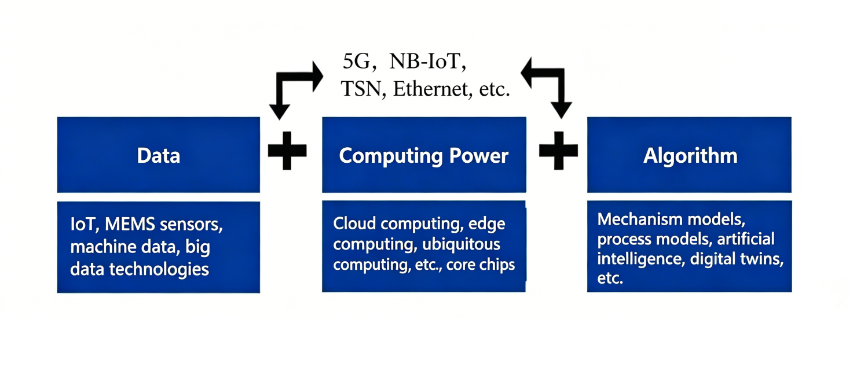
“Data + computing power + algorithms” constitutes the core technical system of intelligent manufacturing. First, data serves as the foundation of the intelligent economy and the core production factor of intelligent manufacturing. Second, the rapid development of computing power represented by cloud computing and edge computing provides strong support for processing massive industrial data. Third, algorithm technologies represented by artificial intelligence and mechanism models enable intelligent manufacturing to identify operational laws and deliver intelligent decision support. Finally, modern communication networks such as 5G closely connect the three core elements, enabling their collaborative operation and releasing tremendous industrial value.
Data
The collection and analysis of industrial data have been practiced since the era of traditional industrial informatization, with massive datasets generated from R&D, manufacturing processes and service segments. The most prominent distinction between conventional industrial data and industrial big data lies in the integration of industrialization and informatization, which realizes the superposition of industrial and automation-domain data. In the Industrial Internet era, more cross-industry data as well as data from upstream and downstream industrial chain links need to be incorporated. Core technologies enabling industrial big data include the Internet of Things (IoT), MEMS sensors and big data technologies.
Computing Power
The advancement of computing power extends in two main directions: centralized resource deployment and edge resource deployment.
The first direction is represented by cloud computing, a centralized computing paradigm. The cloud transformation of IT infrastructure has brought profound industrial changes and lowered enterprises’ costs of capital construction, operation and maintenance.
The second direction is represented by edge computing, which is closely coupled with the development of the Internet of Things. The proliferation of IoT technology has spawned a wide variety of intelligent terminals deployed at the network edge. Cloud computing models come with inherent limitations and cannot satisfy all application scenarios. Massive IoT terminals tend to operate autonomously, enabling local execution of computing tasks. This drastically cuts computing, transmission and storage overhead and delivers higher computational efficiency.
Algorithms
An algorithm refers to a finite sequence of concrete computational procedures, consisting of well-defined instructions that process input data through successive calculations to generate an output. Widely deployed across all links of intelligent manufacturing, algorithms constitute the core enabler of the manufacturing industry’s intelligent transformation.
Based on in-depth research into the current maturity of the core technical system for intelligent manufacturing and forecasts for its large-scale commercial rollout, the preliminary framework of intelligent manufacturing took shape around 2020, characterized by five core features: data-driven operation, software-defined systems, platform-based support, value-added services and intelligence-led decision-making.
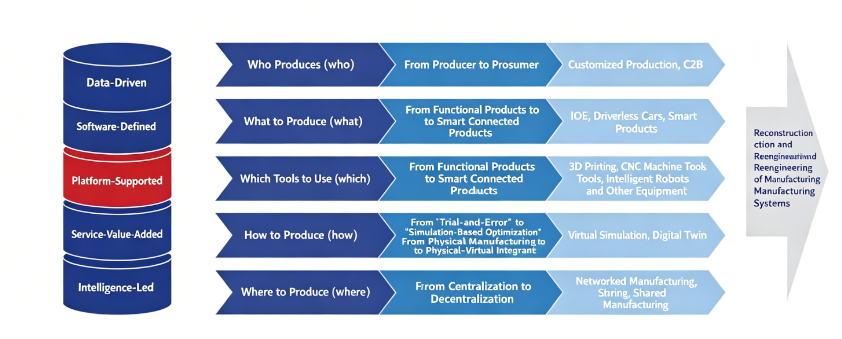
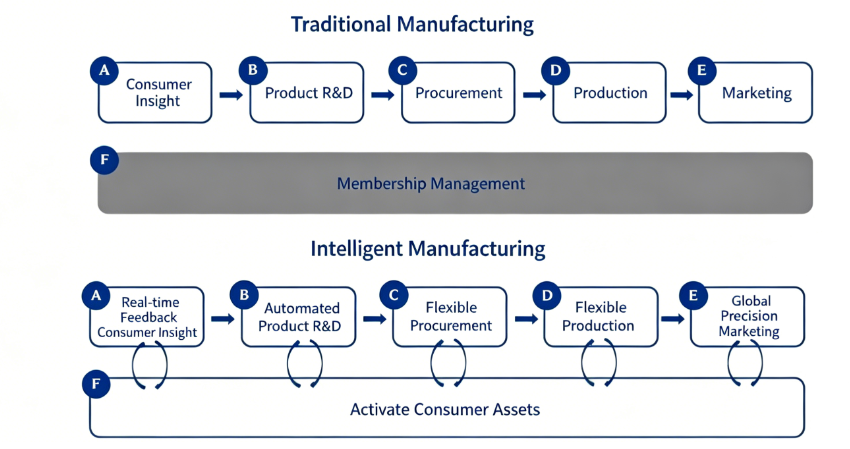
The technical cluster of "Data + Computing Power + Algorithms" empowers and restructures the manufacturing industry across five core industrial chain links: demand insight, R&D, procurement, production, marketing and after-sales service. Compared with traditional manufacturing systems, the intelligent manufacturing production system boasts distinct advantages as follows: consumer insight shifts from indirect to direct; R&D workflows evolve from serial to parallel operations; procurement realizes automation, low inventory and socialized supply; full-scale intelligence is achieved in production processes; and pervasive intelligent marketing and after-sales services are delivered.
Based on in-depth research and real enterprise case studies, the report summarizes four empowerment paths of intelligent manufacturing and their tremendous value to enterprises:
1.Satisfy customized demands via mass supply to restructure the long-tail market;
2.Accurately capture user demands and launch new products rapidly to deliver agile response;
3.Integrate industrial brains with industrial insights to redefine human-machine boundaries and realize intelligent decision-making;
4.Build a highly collaborative intelligent manufacturing ecosystem through industrial internet.
Long-tail Market Restructuring
The Internet is evolving from a network for information exchange and product transactions toward a platform for capability transactions. Within this new transformation, the core challenge for the Industrial Internet is addressing highly fragmented and personalized demands, and delivering real-time, precise, scientific responses to diverse emerging requirements. Against this backdrop, the C2M (Customer-to-Manufactory) customized production model has emerged as a new trend of the industrial revolution.
Agile Response
Agile manufacturing means manufacturing enterprises deploy modern communication tools to rapidly allocate resources (technology, management, manpower included), respond to user demands in an efficient and coordinated manner, and achieve manufacturing agility. Driven by the Consumer Internet’s boost to Industrial Internet development, an important metric of manufacturing agility lies in the speed of new product launches — a critical leverage for enterprises to explore new markets and build competitive edges.
Intelligent Decision-Making
In manufacturing, the redefinition of human-machine boundaries manifests in intelligent factories where humans endow machines with intelligence, and machines undertake complex decision-making and logical control tasks anytime and anywhere. This future factory model is built upon the integration of intelligence, digitalization and automation, transforming factories from "unintelligent facilities" to facilities equipped with industrial brains, marking another leap forward following the three industrial revolutions.
Simply put, the reasoning logic of an industrial brain follows the loop: data → knowledge → data. Massive production data is combined with expert experience, modeled with cloud computing to generate actionable knowledge, which is then applied to resolve or prevent production issues. Meanwhile, empirical knowledge is digitized for large-scale replication and deployment. A complete industrial brain consists of four core modules: cloud computing, big data, machine intelligence and expert experience.
High-level Collaboration
According to the Alliance of Industrial Internet, an industrial internet platform is an industrial cloud platform tailored to manufacturing’s digital, networked and intelligent transformation needs. It constructs a service system built on the collection, aggregation and analysis of massive industrial data, supporting universal connection, flexible supply and efficient allocation of manufacturing resources, and plays a pivotal role in socialized resource collaboration.
Its collaborative capabilities cover four dimensions: intra-enterprise production collaboration, cross-enterprise capacity sharing, cross-industry industrial coordination, and industry-finance integration collaboration between manufacturers and financial institutions.
Conclusion
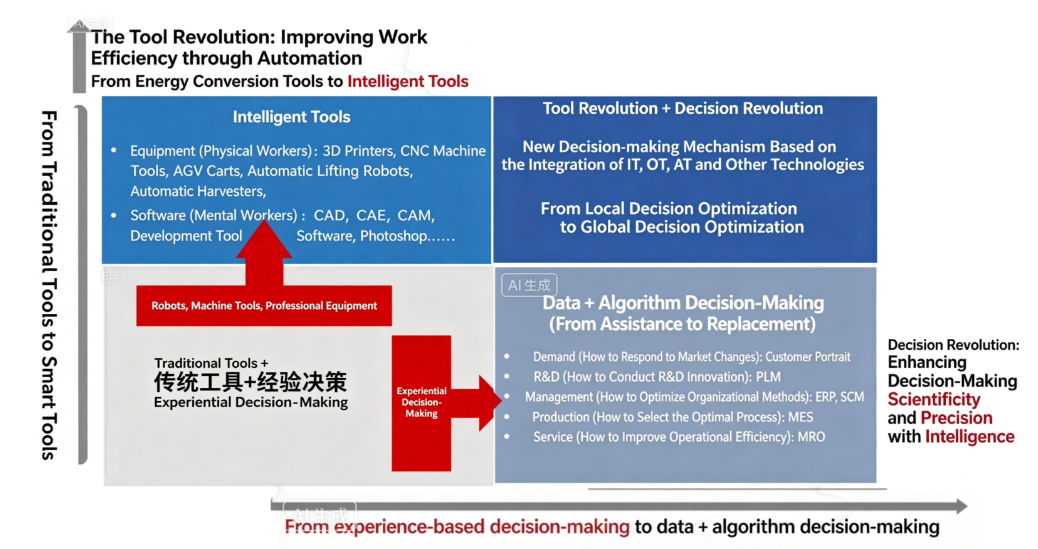
From the perspectives of economic growth and corporate development, intelligent manufacturing subverts the centuries-old development model of traditional industries — "conventional tools + empirical decision-making", triggering profound revolutions in two dimensions: production tools and decision-making systems.
The tool revolution drastically lifts production efficiency, while the decision revolution leverages artificial intelligence and other technologies to improve the accuracy, timeliness and rationality of decision-making, enabling truly intelligent manufacturing.
“The essence of intelligent manufacturing lies in resolving uncertainties through the automatic flow of data: delivering accurate data automatically to the right personnel and machines at the right time and via the right methods, so as to optimize the efficiency of resource allocation.”
As a pacesetter in intelligent manufacturing powered by next-generation AI technologies, Zhitong Technology actively responds to and implements the national “Intelligent Plus” development strategy. We are pioneering a comprehensive intelligent transformation path for the manufacturing sector, leveraging AI technologies to support more enterprises in intelligent upgrading and high-quality growth.
AI Empowers Industrial Upgrading — Zhitong Technology in Action
Built on technologies and products including knowledge graphs, natural language processing, big data and the Internet of Things, we develop two core business lines: intelligent semantics and intelligent manufacturing, alongside three flagship platforms — Semantic Cube, Knowledge Engineering Platform and Digital Factory Platform.
Driving industrial upgrading with AI, Zhitong Technology has partnered with benchmark enterprises and institutions across industries, including Sinopec, Bank of China, Mengniu Group, Bright Dairy, Ausnutria, Haidilao Hot Pot and the Ministry of Natural Resources to implement intelligent AI applications. We aim to empower more clients through technological innovation and jointly build intelligent enterprises.
Source: Information Technology and Software Service Network