







Smart Factory Construction: How to Build the Perfect Human-Machine Partnership
The application of information technologies including artificial intelligence, the Internet of Things and big data has driven the intelligent upgrading of traditional factories. Currently, the construction of smart factories has become a core goal of the manufacturing industry. In this transformation process, how to achieve optimal human-machine collaboration has emerged as a crucial issue.
Enterprises should neither blindly pursue automation and robot replacement of manual labor nor stick to labor-intensive production modes. It is vital to organically combine the strengths of automated equipment — high efficiency and stability in repetitive operations — with workers’ flexibility and situational judgment. In this way, production efficiency can be maximized while ensuring consistent product quality.
Manufacturing enterprises with different production modes vary greatly in terms of production automation level.
Enterprises adopting mass repetitive production modes, such as manufacturers of electronic components, standard fasteners, pharmaceuticals, food, beverages, steel and chemical products, need to maximize automation, manpower reduction and even unmanned production. As pointed out by an expert in the pharmaceutical industry, human intervention is the biggest source of contamination in pharmaceutical production processes.
By contrast, enterprises engaged in small-batch and multi-variety production, including make-to-order (MTO) manufacturers of machinery, auto parts and electrical products, should prioritize human-machine integration by combining workers’ wisdom and experience with automated equipment and production lines. For enterprises undertaking small-batch, multi-variety and single-piece small-batch production, the standardization, serialization and modularization of components are of great significance. A higher level of modularization creates greater possibilities for automation in production and assembly processes.
Enterprises adopting engineer-to-order (ETO) single-piece production modes, such as heavy equipment manufacturers and shipbuilding enterprises, rely heavily on workers to operate equipment. Workers complete machining and assembly processes by drawing on practical experience and process documents, with various auxiliary devices widely deployed on production sites.
For high-end products such as luxury goods, the exquisite craftsmanship and professional spirit of skilled workers are irreplaceable. During an inspection tour of the Glashütte Original watch factory organized by e-works, it was observed that although CAD/CAM technologies and CNC machine tools are applied in product design and partial component machining, core processes including polishing and assembly of high-end watches are still completed purely by hand. A visit to Audi’s German factory also found that while the Audi A8 production line achieves a high degree of automation, the R8 sports car produced in the same factory is mostly manufactured manually.
In the manufacturing process of complex products, different process links feature significantly different levels of automation.
For large complete vehicle manufacturers, stamping, welding and coating processes have achieved high automation, while the final assembly process remains less automated and highly dependent on manual operation. For electronic products such as mobile phones and home appliances, the SMT (Surface Mount Technology) process is fully automated, yet product assembly and testing still require a large amount of manual work. Therefore, enterprises should not simply take the automation rate as the evaluation standard for smart factory construction. Based on industrial characteristics, they should carry out continuous improvement on the basis of lean production and component standardization, serialization and modularization, gradually increase the automation level, and ultimately realize human-machine integration and flexible automation.
In 2015, the e-works delegation visited two assembly lines at Siemens Amberg Electronics Factory. The first line, which only produces two types of products, realizes fully automatic assembly. The second line is designed for the assembly of dozens of different products and adopts a semi-automatic mode, with half of the stations relying on manual assembly. The manual stations are equipped with mistake-proof design: the component box lights up green to indicate the parts to be assembled for specific products at each station.
In the construction of smart factories, the rational application of smart equipment and supporting technologies can effectively reduce workers’ labor intensity and improve production efficiency.
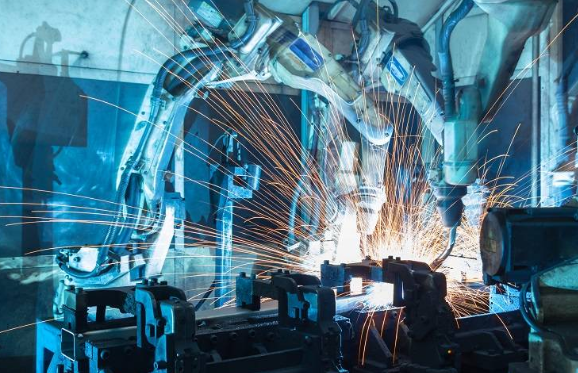
For instance, industrial robots are widely used in welding, spraying, material handling, stacking, grinding and other processes. AGVs and hanging systems have replaced manual material transportation. Machine vision technology enables automatic visual inspection; in the SMT industry, for example, it captures images of circuit boards and compares them with standard templates to realize automatic quality inspection, replacing manual visual checking. Voice recognition technology assists workers in accurate material picking, and Honeywell has already developed relevant products for this scenario.
The integration of industrial robots and machine vision technology has greatly improved the application performance of industrial robots. Collaborative robots further expand the application scenarios of robotic equipment and optimize human-machine integration. The APAS production assistance system launched by Bosch is a mobile manipulator that supports manual work and realizes synchronous collaboration with workers. Industrial robots should be vigorously promoted in processes that are harmful to workers’ health.
Jin Ming, an expert in intelligent manufacturing, pointed out that manual operation remains dominant in certain scenarios even when automated equipment is available.
In some production links, although robots and automated equipment can replace manual labor, they are prone to errors and cannot match the sensitivity and accuracy of human movements and perception.
For production processes with low operation rhythms, enterprises still prefer manual operation due to the high cost of robotic and automated equipment.
While the adoption of smart equipment reduces the demand for ordinary production workers, it greatly increases the market demand for high-skilled technicians who can operate, maintain and repair intelligent production equipment.
Reviewing the development of intelligent manufacturing equipment, the industry has evolved from ordinary machine tools and CNC machine tools to automatic tool-changing machining centers, turn-milling composite machining centers capable of multi-process integration, and error-compensated machining centers that integrate machining and detection functions, with continuous improvement in intelligence level.
Meanwhile, the application of smart equipment has expanded from single-unit operation to combined operation of multiple devices, forming intelligent manufacturing cells (or flexible manufacturing systems). On this basis, enterprises integrate various intelligent logistics equipment to build intelligent production lines. The continuous upgrading of equipment intelligence, coupled with the integration of data collection, equipment networking and CNC programming functions, has made equipment operation, maintenance and repair increasingly complex. This not only raises higher technical requirements for frontline workers, but also drives the growing demand for outsourced equipment maintenance services.
At present, digital factory simulation software can realize ergonomic simulation. A variety of auxiliary devices have also been developed to adjust the height and orientation of products during manufacturing and assembly, ensuring that workers can maintain a comfortable working posture throughout the production process.
In conclusion, when planning smart factory construction, manufacturing enterprises should not blindly pursue unmanned factories, dark factories or full robot replacement. Instead, they shall reasonably arrange the application of smart equipment and production lines according to their own product characteristics and production modes, so as to achieve efficient and integrated human-machine collaboration.
Source: Information Technology and Software Service Network