








The Soul of Intelligent Manufacturing Systems — The Intelligent "Nervous System"
Intelligent manufacturing is a brand-new production mode generated from the systematic application of new-generation information technologies, automation technologies, industrial software and modern management philosophies across all business segments and full production workflows of manufacturing enterprises. Building an intelligent manufacturing system means deploying this production mode into manufacturers’ production and operation activities, enabling enterprises to become smarter in R&D, production, management, services and other links, and ultimately realizing intelligent manufacturing.
Intelligent Manufacturing System = Intelligent "Nervous System" + Automated Equipment
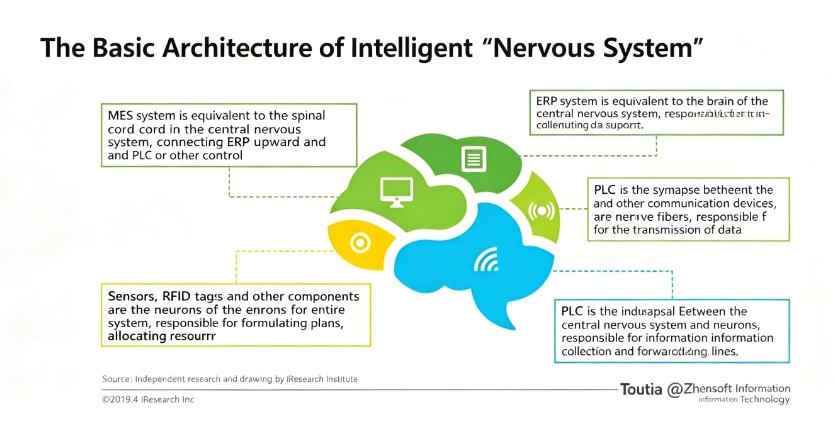
The construction of an intelligent manufacturing system can be interpreted as follows: on the basis of introducing production equipment such as CNC machine tools and industrial robots to realize production automation, enterprises are further equipped with a sophisticated intelligent "nervous system". The intelligent "nervous system" refers to a complete set of data collection, circulation and analysis platforms: its central nervous system consists of management software including ERP (Enterprise Resource Planning) and MES (Manufacturing Execution System) that realize vertical data integration; its neurons are components such as sensors, embedded chips, RFID tags and barcodes; PLC (Programmable Logic Controller) acts as synapses connecting and controlling neurons; and communication technologies including fieldbus, industrial Ethernet and NB-IoT serve as nerve fibers. Relying on this intelligent "nervous system", enterprises can perceive operating environments, acquire real-time information and transmit production instructions, so as to achieve scientific decision-making, intelligent design and optimized production scheduling. It helps improve equipment utilization, monitor equipment conditions, guide equipment operation, and allows automated production equipment to be controlled with great ease and precision.
The Central Nerves of the Intelligent "Nervous System" — ERP + MES
If we draw an analogy between the human nervous system and the factory’s intelligent "nervous system", ERP can be compared to the brain and MES to the spinal cord; together they form the central nervous system of an intelligent manufacturing system.
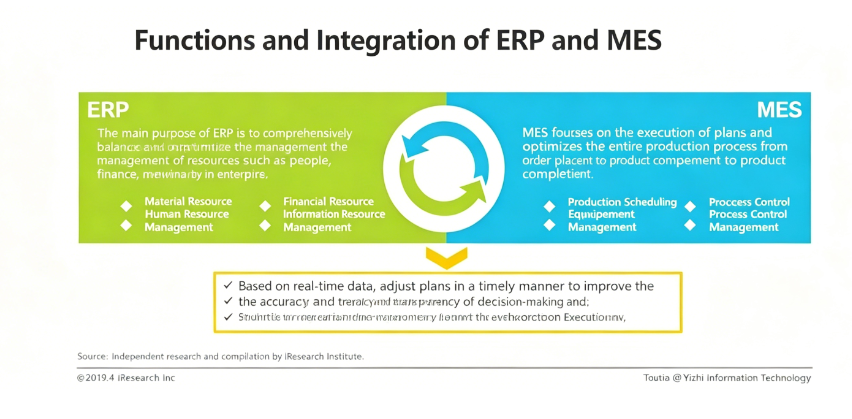
ERP is the top-tier enterprise resource management system, focusing on pre-control of corporate operations. Its core functions are to manage, rationally allocate and precisely utilize all available corporate resources, as well as deliver decision support for management. MES, by contrast, is a workshop-level management information system dedicated to production management and dispatching execution. It eliminates the "black box" problem of on-site manufacturing processes, realizing full visibility and controllability of production workflows.
ERP and MES occupy an absolutely core position within manufacturers’ information architectures, yet each has distinct limitations. ERP excels at planning and scheduling but cannot identify production bottlenecks or drive product quality improvements. MES centers on shop-floor execution, while financial, sales and other back-office business processes lie outside its monitoring scope.
To build a robust intelligent "nervous system", enterprises must integrate ERP and MES — much like unblocking the two key energy meridians in traditional Chinese medicine. Their integration creates a closed-loop system covering planning, control, feedback and adjustment. Through standardized unified interfaces, production plans and operational orders are issued, while real production performance data is fed back. This enables transparent, timely and seamless exchange of production schedules, control instructions and live status data across ERP, MES, process control systems and automated equipment, ultimately delivering full digitalization of the entire manufacturing lifecycle.
The Synapse of the Intelligent "Nervous System" — PLC
PLC stands for Programmable Logic Controller. It mainly consists of a CPU, memory, input/output units, peripheral I/O interfaces, communication interfaces and power supply. Programmers, printers and other external devices can be configured according to the actual demands of controlled objects. Equipped with functions including logic control, sequence control, timing and counting, PLC can fulfill control tasks for all kinds of mechatronic equipment.
Within an intelligent manufacturing system, PLC acts not only as the controller for machinery and production lines, but also as a collector and forwarder of manufacturing information, analogous to the "synapse" in a biological nervous system. On one hand, it gathers and reads equipment status data and feeds it back to upper-level systems (SCADA/DCS or MES); on the other hand, it receives and executes instructions issued by upper systems to directly control production equipment at the shop floor layer.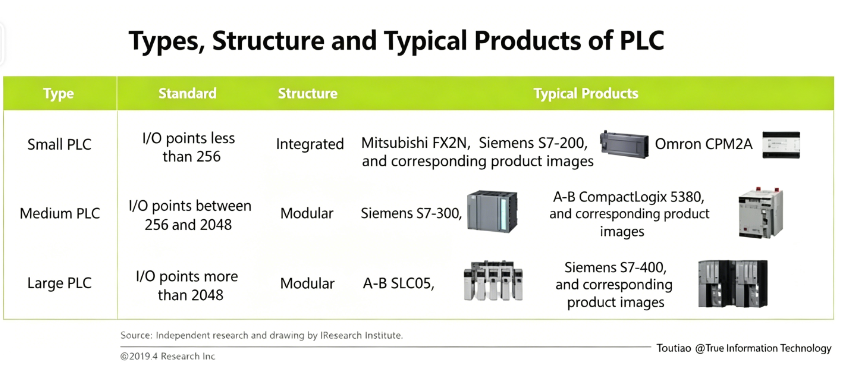
The Neurons of the Intelligent "Nervous System" — Sensors and RFID Tags
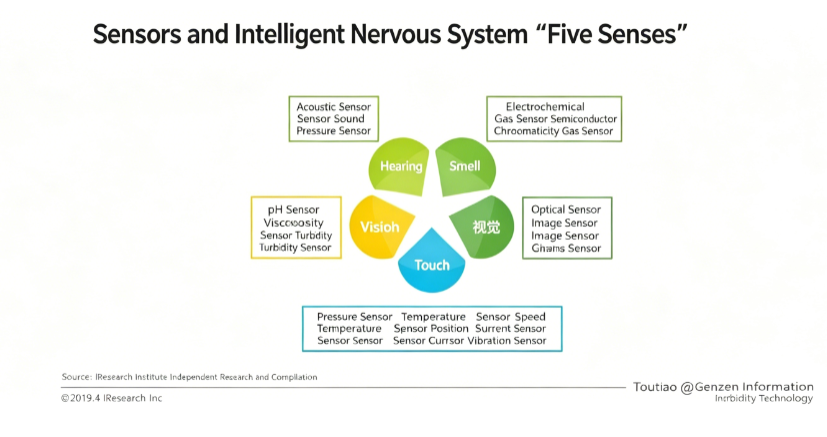
Neurons are the fundamental building blocks of a nervous system. Within the factory’s intelligent "nervous system", this role is fulfilled by components directly interfacing with physical objects such as materials, work-in-progress goods, production equipment and on-site environments, including sensors, RFID tags and barcodes. Sensors and RFID tags constitute the front-end data sources that enable the intelligent manufacturing system to perceive the physical world.
Sensors detect measurable physical information and convert the captured data into electrical signals or other standardized output formats. They endow intelligent manufacturing systems with sensory capabilities equivalent to the human sense of touch, taste and smell.
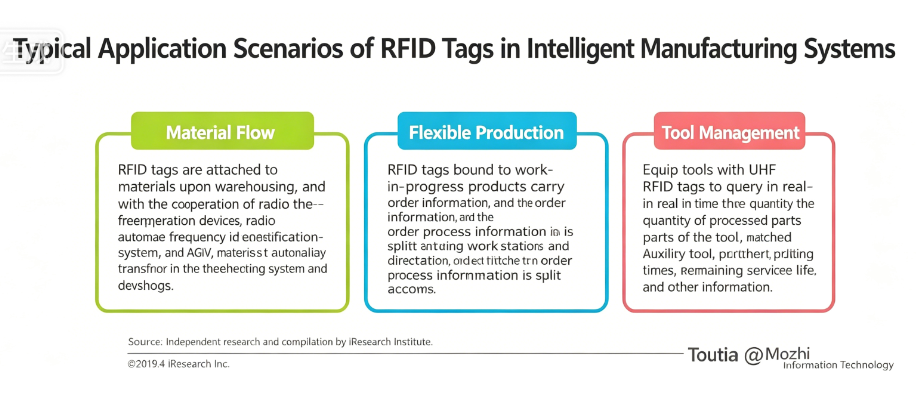
RFID tags feature outstanding advantages including fast reading, batch identification, real-time communication, reusability and dynamically editable tag data, which perfectly match the demands of intelligent manufacturing. With radio frequency identification technology, enterprises can monitor all physical assets affixed with RFID tags, such as raw materials, cutting tools, work-in-progress goods and finished products. This helps businesses reduce stock shortages and acquire logistics data rapidly and accurately.
The Nerve Fibers of the Intelligent "Nervous System" — Industrial Communication Networks
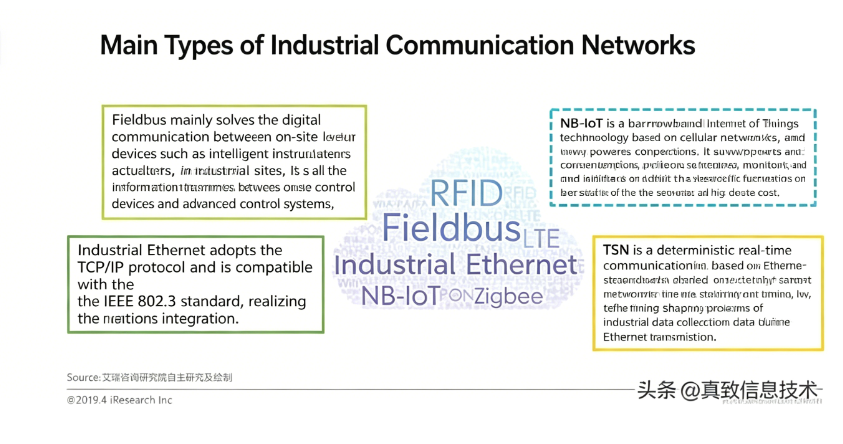
Massive volumes of data are generated across all links of daily enterprise operations, including R&D, planning, production, process engineering, logistics, warehousing and inspection. To enable smooth circulation of huge datasets within the intelligent "nervous system", enterprises need to build a complete nerve fiber network by integrating multiple industrial communication networks such as fieldbus, industrial Ethernet, industrial fiber optic networks, TSN and NB-IoT. Industrial communication networks are generally categorized into wired communication networks and wireless communication networks.
Wired communication networks mainly cover fieldbus, industrial Ethernet, industrial fiber optic networks and TSN (Time-Sensitive Networking). At present, wired communication technologies dominate data collection for on-site industrial equipment. They satisfy the demand for real-time data acquisition, upload and live monitoring of manufacturing processes.
Wireless communication technologies are gradually penetrating industrial data collection as a vital supplement to wired networks, divided into three main types:
Short-range communication technologies (RFID, Zigbee, Wi-Fi, etc.), applied to read sensor data within workshops/factories, manage goods and assets, and provide network access for wireless equipment such as AGVs;
Dedicated industrial wireless standards (WIA-PA/FA, WirelessHART, ISA100.11a, etc.);
Cellular wireless communication technologies (4G/5G, NB-IoT), for connecting smart finished goods outside factories, large long-distance mobile machinery and handheld terminals.
The Intelligent "Nervous System": The Core Backbone of Intelligent Manufacturing System Architecture
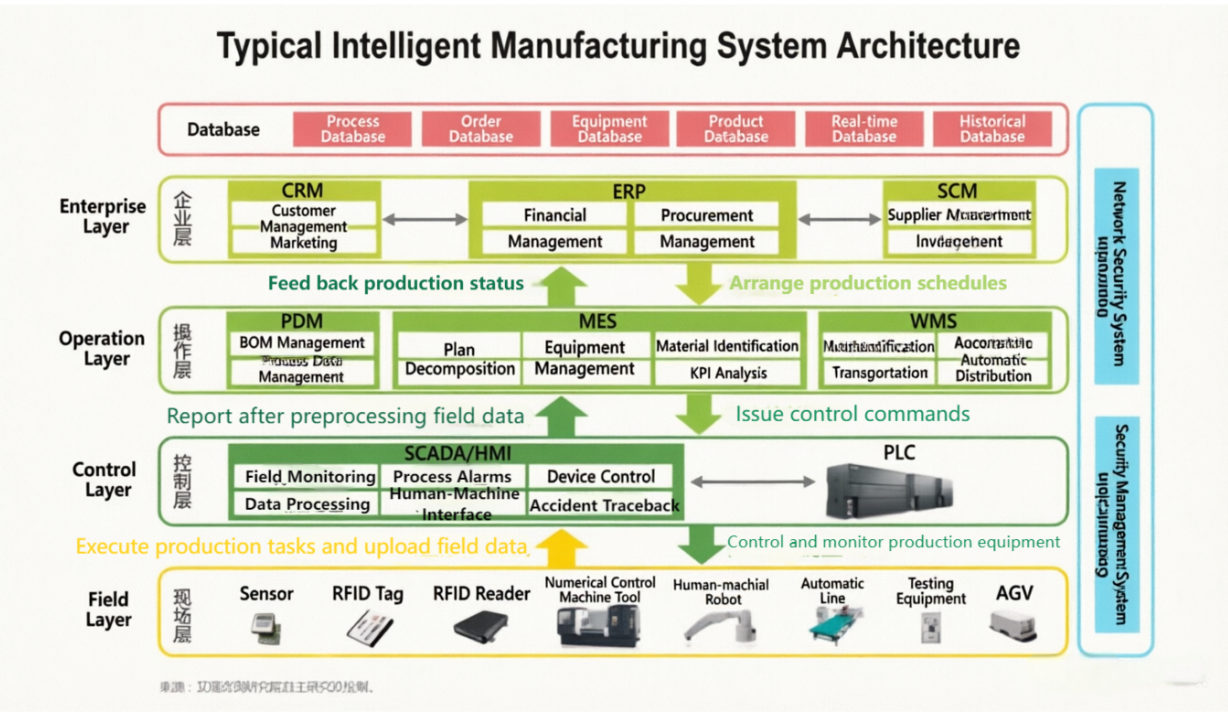
A complete intelligent "nervous system" plays an irreplaceably critical role in intelligent manufacturing. It governs the full closed-loop production workflow of manufacturing enterprises — formulating production schedules, issuing work orders, executing manufacturing tasks, monitoring production equipment, uploading on-site data, preprocessing and relaying field data, feeding back overall production status, and readjusting production plans. Throughout all these procedures, the intelligent "nervous system" takes charge of command issuance, information collection, data processing and data transmission.
Serving as the central backbone, operational core and essential soul of the entire intelligent manufacturing system, the intelligent "nervous system" underpins all operations of smart factories.
Source: Information Technology and Software Service Network