






Challenges and Bottlenecks of "Smart + Manufacturing" in China
The in-depth integration of new-generation information technologies such as artificial intelligence and big data with traditional manufacturing technologies has brought tremendous transformations to China’s manufacturing industry, making intelligent manufacturing the primary development goal for traditional manufacturers. Nevertheless, the implementation of the "Smart + Manufacturing" initiative cannot be accomplished overnight; its rollout presents both opportunities and challenges.
As widely recognized, China has long been acknowledged worldwide as a major manufacturing country. However, its manufacturing strengths lie chiefly in production costs, concentrated largely in resource-intensive and labor-intensive industries. Over recent years, China’s manufacturing sector has also faced dual pressures from rising labor and raw material costs. Its traditional cost advantages are fading rapidly, making industrial transformation an urgent imperative for the entire manufacturing industry.
Against this backdrop, this year’s government work report explicitly proposes advancing the transformation and upgrading of traditional industries. Focusing on advancing high-quality development of manufacturing, the report underscores the need to consolidate industrial foundations and boost technological innovation capacity, advance integrated development of advanced manufacturing and modern service industries, and speed up efforts to build China into a manufacturing powerhouse.
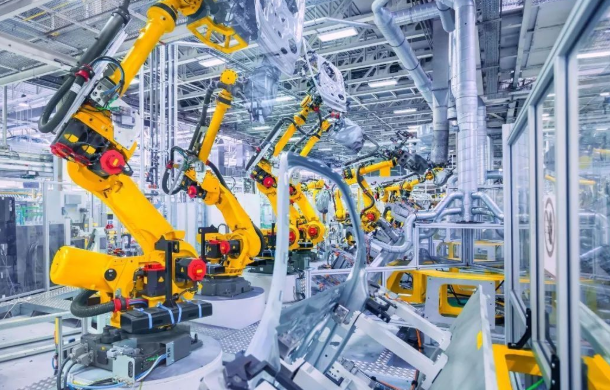
Notably, when addressing the transformation and upgrading of traditional industries and high-quality development of manufacturing, the government work report specifically highlights the initiative to "expand the application of the 'Smart Plus' model to empower the transformation and upgrading of manufacturing industries".
Against this backdrop, three core questions arise: How can manufacturing industries integrate the "Smart Plus" model? In what dimensions can "Smart Plus" help manufacturers cut costs and boost efficiency? And what pain points and bottlenecks will emerge during on-site implementation?
The Era of Smart + Manufacturing Has Arrived
Over the past few years, numerous industry concepts have emerged regarding the empowerment of manufacturing via new technologies, including Intelligent Manufacturing, Internet Plus Manufacturing, and AI Plus Manufacturing. What exactly distinguishes these concepts from one another?
Intelligent Manufacturing prioritizes deploying traditional industrial software across manufacturing operations, fundamentally realizing digitalization and automation. Internet Plus Manufacturing leverages internet tools for manufacturing, focusing on matching and balancing supply and demand; the booming Industrial Internet of recent years represents the industrial variant of the Internet Plus model. AI Plus Manufacturing centers on applying artificial intelligence technologies to manufacturing. It achieves intelligence built upon digitalization and networking, with its core value lying in enabling machines to possess real-time autonomous operational capabilities.
It is evident that the evolution from Intelligent Manufacturing to Internet Plus Manufacturing, and now to Smart + Manufacturing, reflects the iterative advancement of technology-enabled manufacturing. As artificial intelligence and associated technologies are integrated into production, they gradually optimize efficiency across all manufacturing links. Relying on machine learning capabilities, these technologies ultimately deliver the ultimate goal: human-machine integrated collaborative manufacturing.
So what impacts will "Smart + Manufacturing" exert on traditional manufacturing industries? We can analyze this from three dimensions:
First, in terms of boosting production efficiency. The adoption of AI-related technologies can minimize human errors, continuously optimize production processes and raise product yield rates. Besides, deploying intelligent robots can take over repetitive and hazardous jobs, while cutting costs related to production waste, time consumption and other areas.
Second, in terms of optimizing industrial structure. Large-scale application of artificial intelligence will thoroughly reshape the traditional industrial landscape and foster both emerging industries and upgraded existing sectors. For instance, empowered by "Smart Plus", the automotive industry can launch new product lines, enabling faster mass production of autonomous vehicles. Furthermore, numerous new enterprises specializing in Smart + Manufacturing will emerge to serve every link of the manufacturing chain.
Third, in terms of reshaping the global division of labor. Improved production efficiency and optimized industrial structure will substantially sharpen the competitiveness of China’s manufacturing sector in the global marketplace. More Chinese manufacturers will be able to capture greater value margins, ultimately fulfilling the goal of building a manufacturing powerhouse.
It should be noted that manufacturing carries a more prominent and weightier position in China’s national economy compared with that of other countries around the world, which will undoubtedly open up broader room for the development of artificial intelligence. Forecasts by the McKinsey Global Institute (MGI) indicate that 51% of jobs in China can be automated in the future. AI is projected to drive around 1.3% of China’s economic growth, a figure higher than the global average.
It is clear that Smart + Manufacturing represents an irresistible general trend, signaling the arrival of a brand-new era centered on Smart + Manufacturing.
Three Business Models of Smart + Manufacturing
What new business models and commercial opportunities will emerge as Smart + Manufacturing moves from concept to practical implementation? Smart + Products, Smart + Services and Smart + Production will undoubtedly become the core research directions for the future.
First, Smart + Products, covering smart chips, smart components and smart applications. In practice, smart chips pose the highest barrier to entry yet boast enormous market potential, as the entire industry demands more powerful and efficient computing power support. Smart components refer to optimized algorithm APIs provided externally for enterprises to call and conduct secondary development. Smart applications involve the direct production of integrated hardware and software AI products, delivering deeper-level support to manufacturing firms.
Second, Smart + Services. Drawing on the massive data accumulated by manufacturers and leveraging artificial intelligence technologies, optimized algorithms enable more comprehensive and accurate user profiling as well as identification of various industrial demands. For example, this model enables real-time, precise information transmission, alongside real-time monitoring, management and risk early warning across all manufacturing links.
Third, Smart + Production. This model deploys integrated hardware and software AI tools to boost productivity within individual manufacturing procedures. For process optimization, machine learning builds holistic product models to identify how different production parameters impact end-product quality, thereby deriving optimal process parameters. Intelligent quality inspection also stands as a critical application within this scenario.
Undoubtedly, the continuous expansion of AI application scenarios will bring substantial transformations to China’s manufacturing sector. Chinese manufacturers are expected to achieve three major goals: the transformation into smart factories, cross-enterprise extension of value chains, and the construction and optimized allocation of an industry-wide ecosystem. In-depth intelligent transformation of manufacturing will no longer remain merely a long-term vision.
Pain Points and Difficulties Facing Smart + Manufacturing
Admittedly, the rollout of Smart + Manufacturing cannot be accomplished overnight. Multiple prominent pain points and challenges persist during implementation, mainly reflected in the following aspects:
First, technological gaps exist, notably the shortage of core independent technologies and original innovations. Key technologies, especially foundational ones, require sustained and massive R&D investment, making qualitative breakthroughs unattainable in the short term. Fortunately, internet giants represented by BAT and Chinese tech innovators led by Huawei are continuously pushing technological innovation. With consistent efforts over time, breakthroughs in core technologies will be achieved.
Second, industrial standards are hard to implement. Manufacturing facilities consist of vast quantities of production equipment, yet incompatibility between hardware and software from different manufacturers is ubiquitous. The standardized top-level design fails to align with the complexity of on-site production processes. Nevertheless, competent authorities are taking the lead to formulate various industrial standards, while industrial alliances are being established across sectors. It is expected that bottlenecks in standardization will be resolved at an early date.
Third, outdated management models persist. The large-scale, standardized production paradigm of the industrial era has fostered multi-tiered, fragmented management systems within manufacturing enterprises. Such frameworks can no longer accommodate fast-changing market demands. With the large-scale rollout of Smart + Manufacturing in the future, companies need to redesign and upgrade legacy management systems based on new human-machine collaboration frameworks.
From this perspective, the manufacturing sector is in urgent need of comprehensive empowerment by artificial intelligence. The integration of Smart Plus and Manufacturing marks a critical leap for China to evolve from a major manufacturing nation into a manufacturing powerhouse, and also presents a valuable window of opportunity for China to overcome domestic and global challenges and forge ahead. Therefore, this transformation journey is long, arduous yet profoundly significant.
Source: Information Technology and Software Service Network