







How 5G Will Transform the Manufacturing Industry
Manufacturers are feeling the squeeze of shrinking product lifecycles. In our fast-paced world, consumers discard devices rapidly and frequently, constantly craving the latest gadgets, the most popular features, and instant on-demand services.
But how can manufacturing firms keep up with this surging demand while continuing to produce increasingly sophisticated goods?
Smart Manufacturing, Industry 4.0, the Digital Enterprise, the Factory of the Future — whatever term you prefer — is revolutionizing the industry as we know it. Unlike the First Industrial Revolution powered by steam and iron (recall the era when steam power was an innovative breakthrough), this industrial revolution fuses computing power and machinery technology to drive better, more efficient workplaces, leveraging cutting-edge information, operational and communication technologies.
According to The Huffington Post, early adopters that have rolled out at least partial smart manufacturing initiatives have achieved tangible results, with 82% reporting improved efficiency. The deployment of 5G will give this revolution a powerful boost.
Qualcomm forecasts that the transition to 5G will add $3 trillion to global GDP and create more than 22 million jobs by 2035, equivalent to generating an economy roughly the size of India. In addition, per Jabil’s 5G Technology Trends Survey, 72% of 5G specialists predict that 5G solutions will first be deployed in commercial use cases, with the Industrial Internet of Things emerging as one of the most powerful short-term growth drivers. Download the full report.

The low latency, higher bandwidth, faster speeds and greater capacity brought by the new generation of wireless technologies are driving the digital transformation of manufacturing across a wide range of fields, such as artificial intelligence, augmented reality, predictive maintenance and collaborative robots.
Unlocking the Potential of Artificial Intelligence
A study released by MarketsandMarkets valued the artificial intelligence (AI) market at USD 16 billion in 2017, and forecasts it will exceed USD 190 billion by 2025 with a compound annual growth rate (CAGR) of 36.6%. As this technology gains widespread adoption and its use cases expand, experts predict it will become a game-changer for the industrial sector. A joint study by Boston Consulting Group and MIT Sloan Management Review found that among 3,000 respondents, 84% believe AI will help them gain or sustain a competitive edge.
Shorter production cycles make it harder for manufacturers to meet demand for increasingly sophisticated products while complying with stringent quality regulations and standards.
Even though products roll off production lines at an unprecedented pace, customers’ expectations for high-quality, feature-rich goods remain unchanged. Companies must cut defect rates and strive to eliminate product recalls — and this is where AI delivers tangible value.
Beyond predictive maintenance, which I will elaborate on later, AI can be deployed to elevate factory quality control. Machine vision inspection systems without AI training require datasets of roughly one million images to identify all potential defects. Artificial intelligence augments existing infrastructure and human resources, enabling workers to rapidly spot errors and faults that compromise production workflows and product quality.
At Jabil, for instance, this technology is deployed to detect defects in the early stages of circuit board manufacturing. Defects can be identified at the second or third step of a 35–40 step production process, with an 80% fault detection accuracy rate. This cuts labor costs by 17% and energy consumption by 10%. Early fault detection boosts operational efficiency, shortens production lead times and lifts customer satisfaction. However, this approach relies on 5G to access massive volumes of real-time, high-quality data and deliver maximum efficiency.
Troubleshooting with Augmented Reality (AR)
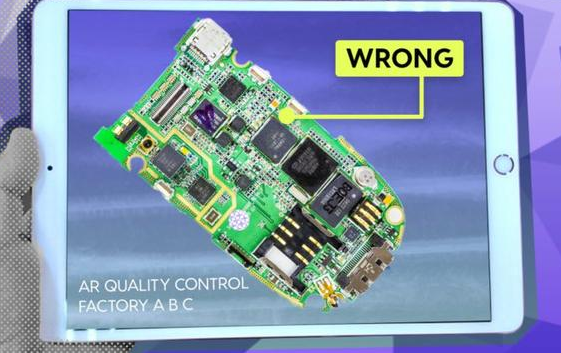
Augmented Reality (AR) also empowers technicians to diagnose faults faster. Unlike Virtual Reality, AR does not obscure the physical world; it overlays digital layers onto real environments. Equipped with AR solutions and tablets, maintenance technicians can pinpoint malfunctions far more quickly and efficiently, cutting time spent on issue resolution and enabling faster cross-site data sharing.
A team of researchers and engineers at Ericsson has already adopted this tool to streamline and optimize troubleshooting workflows.
The company found its technicians spend around half of their maintenance time on non-value-added tasks, such as searching for and cross-referencing schematics, layout files, fault logs and troubleshooting guides. AR drastically reduces time wasted locating root causes, freeing up technicians to focus on high-value work that benefits the business.
Leveraging Predictive and Preventive Maintenance
Poor maintenance strategies can drag down overall factory production capacity by 5% to 20%. Research also indicates unplanned downtime costs industrial manufacturers approximately USD 50 billion annually, with equipment failures accounting for 42% of all unplanned outages. This creates a dilemma for manufacturers: shutting down machinery for scheduled maintenance halts production, yet running equipment beyond its service lifespan leads to breakdowns and far longer production halts.
The optimal solution is to maximize the efficiency of planned downtime while eliminating unplanned outages — this improves equipment utilization, boosts staff productivity and ultimately lifts profitability.
Traditional preventive maintenance relies on manual calculations and excessive overtime that manufacturers can ill afford. The process is both cumbersome and inefficient due to its heavy time investment.
PwC states that nearly 100% of manufacturers aim to improve efficiency via digital technologies like predictive maintenance, and the adoption of machine learning and analytics for predictive maintenance among manufacturers is projected to rise by 38% over the next five years. Combined with 5G wireless capabilities, manufacturers can implement simpler, more effective predictive and preventive maintenance workflows.
Studies show that improving the accuracy of performance degradation detection across manufacturing scenarios can slash related costs by 50% or more.
Replacing Wi-Fi with 5G
While Wi-Fi has transformed our lives and expanded our capabilities in countless ways, we have all seen the spinning loading icon on laptop screens while waiting for web pages to load. On the factory floor, such frustrating delays come with steep costs, dragging down productivity and eroding profit margins.
Mobile internet connectivity already outperforms Wi-Fi in some regions. To capitalize on faster data speeds and superior reliability, a growing number of manufacturers — especially those in the automotive sector — are exploring private 5G networks. Beyond delivering a 10x or greater speed boost and 50x lower latency than Wi-Fi, 5G supports far more connected devices than 4G. This is highly valuable for IoT operators deploying masses of connected hardware within concentrated industrial sites, namely manufacturing plants.
According to MIT Technology Review, 5G can be programmatically configured to prioritize different types of data and devices. For example, mission-critical industrial equipment can be guaranteed uninterrupted operation even if other segments of the network experience outages.
German automaker Audi plans to roll out its own private 5G network over the coming years, viewing it as an essential investment to ensure manufacturing robots and other equipment operate faster and more securely than legacy internet solutions. Other automotive OEMs including BMW, Daimler and Volkswagen are likely to follow suit.
Enhancing Supply Chain Management
From production to final delivery, packages pass through numerous handlers and inspection checkpoints, raising complex questions around liability, ownership and supply chain insurance. If goods arrive damaged, when did the damage occur, and which party is accountable? End-to-end delivery visibility is critical to effective supply chain management.
Unfortunately, conventional tracking tools such as QR code scanning and radio frequency identification (RFID) only log product records upon arrival, capturing basic location and timestamp data. In the event of damage, tracing exactly which stage of the logistics journey caused the issue is difficult, if not impossible.
Smart packaging technology has made significant strides, yet next-generation wireless technology will take package tracking to an entirely new level. By embedding 5G sensors into packaging, supply chain stakeholders gain real-time access to granular shipment data including location, temperature, humidity, G-force exposure and moisture levels. Real-time updates on product condition eliminate the need for manual checkpoint inspections.
Boosting Safety and Efficiency Through Human-Robot Collaboration
A MIT study found that collaboration between human workers and robots at BMW factories cut employee idle time by 85%, delivering an immediate productivity uplift. Enhanced robotic functionality allows these machines to adapt to shifting operating conditions and perform a diverse range of tasks.
Robotics has long been deployed for automated assembly lines to mass-produce vehicles and other manufactured goods at scale. Robots also handle material transport, or perform basic housekeeping to clear clutter from factory floors. Similar automated robots have been rolled out in grocery retail: GIANT/MARTIN’S and Stop & Shop recently launched one of America’s largest in-store robotics deployments in partnership with Badger Technologies. Affectionately nicknamed “Marty”, these vision-equipped machines patrol store aisles to clean up spills and mitigate safety hazards. While automated robots handle tedious, repetitive tasks to maintain hazard-free workspaces, human employees can focus on higher-value work.
Though autonomous robots are already widely deployed in factories and retail spaces worldwide, real-time interaction between robots and their surrounding environments requires near-instant transmission of massive datasets. The heavy on-board computing intelligence required by robots creates a major dilemma for manufacturers. Currently, firms must build complex machinery and control systems, which lengthen development cycles and slow innovation in new application areas.
5G-powered cloud robotics resolves these pain points by shifting core system intelligence to the cloud and simplifying on-site robotic hardware, improving usability and operational efficiency. High-performance, reliable connectivity enabled by 5G is the cornerstone of production robotics optimization. By processing data closer to its source, 5G delivers drastically faster speeds than previous generations of wireless technology with marked performance improvements. 5G also offers superior flexibility, allowing manufacturers to adapt to evolving production environments with minimal modification costs.
Ericsson notes that while multiple industries stand to benefit from cloud robotics, manufacturing is one of the front-runners in cloud technology adoption. Nokia’s manufacturing plant in Oulu, Finland operates with nearly 100% automated workflows, and the company aims to further enhance its operations via 5G.
5G is poised to reshape the world in countless ways: from ultra-high-speed video streaming and self-driving vehicles to remote surgery powered by real-time low-latency responses. Its unprecedented speed and coverage will connect the globe more tightly than ever before and unlock transformative new capabilities, revolutionizing numerous industries — manufacturing included.
Source: Information Technology and Software Service Network